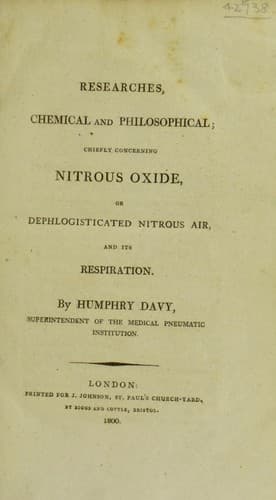
Researches Chemical and Philosophical; Chiefly concerning nitrous oxide: or dephlogisticated nitrous air and its respirationDavy, Humphry, Sir
Science
Researches Chemical and Philosophical; Chiefly concerning nitrous oxide: or dephlogisticated nitrous air and its respiration
Davy, Humphry, Sir
Nitrous oxide
A porcelain tube was provided, open at both ends, and well glazed
inside and outside, its diameter being about,5 inches. To one end of
this, a glass tube was affixed, curved for the purpose of communicating
with the water apparatus. With the other end a glass retort was
accurately connected, containing a mixture of perfectly caustic slacked
lime, and muriate of ammoniac.
The water in the apparatus for receiving the gases had been previously
boiled, to expel the air it might contain, and during the experiment
was yet warm.
When the tube had been reddened in a furnace adapted to the purpose,
the flame of a spirit lamp was applied to the bottom of the retort. A
great quantity of gas was collected in the water apparatus; of this the
first portions were rejected, and the last transferred to the mercurial
trough.
A small quantity examined, did not at all diminish with nitrous gas,
and burnt with a lambent white flame, in contact with common air.
2¾ of this gas, equal to 110 grain measures, were fired with 2, equal
to 80, of oxygene, in a detonating tube, by the electric spark. They
were reduced to 2¼, or 90. On introducing to the remainder a solution
of strontian, it became slightly clouded on the top, and an absorption
of some grain measures took place.
It was evident, then, that in this experiment, charcoal[61] had been
somehow present in the tube; which being dissolved by the nascent
hydrogene, had rendered it slightly carbonated, and in consequence made
the results inconclusive.
[61] Though the tube had never been used, and was apparently clean and
dry on the inside, it must have contained something in the form of
dust, capable of furnishing either hydrocarbonate, or charcoal.
A tube of thick green glass carefully made clean, was now employed,
inclosed in the porcelain tube. Every other precaution was taken to
prevent the existence of sources of error, and the experiment conducted
as before.
140 grain measures of the gas produced, fired with 120 of oxygene,
left, in two experiments, nearly 110. Solution of strontian placed in
contact with the residuum, did not become clouded, and no absorption
was perceived.
Now 150 measures of gas were destroyed, and if we take Lavoisier’s
and Meusnier’s estimation of the composition of water, and suppose
the weight of oxygene to be 35 grains, and that of hydrogene 2,6 the
hundred cubic inches; the oxygene employed will be to the hydrogene as
243 to 576. Put _x_ for the oxygene, and _y_ for the hydrogene.
Then _x_ + _y_ = 150
_x_ : _y_ :: 243 : 576
243_y_
_x_ = ——————
576
819_y_ = 86400
_y_ = 105 _x_ = 45
And 140 - 105 = 35
Consequently, the nitrogene in ammoniac is to the hydrogene as 35: 105
in volume: and 13,3 grains of ammoniac are composed of 10,6 nitrogene,
(supposing that 100 cubic inches weigh 30,45 grains) and 2,7 hydrogene.
Public-domain text, read in full here on John Shaqi.
Reviews
Reviews
No reviews yet
Be the first to share your thoughts on this work.
Join the Discussion
Join the discussion
Sign in to leave a comment or review.
Sign InorCreate an account