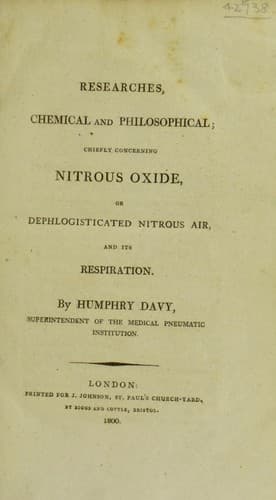
Researches Chemical and Philosophical; Chiefly concerning nitrous oxide: or dephlogisticated nitrous air and its respirationDavy, Humphry, Sir
Science
Researches Chemical and Philosophical; Chiefly concerning nitrous oxide: or dephlogisticated nitrous air and its respiration
Davy, Humphry, Sir
Nitrous oxide
According to Berthollet, the weight of the nitrogene in ammoniac is to
that of the hydrogene as 121 to 29.[62] The difference between this
estimation and mine is so small as to be almost unworthy of notice, and
arises most probably from the slight difference between the accounts
of Lavoisier and Monge, of the composition of water, and the different
weights assigned to the gases employed.
[62] Journal de Physique, 1786, t. 2, 177.
We may then conclude, that 100 grains of ammoniac are composed of about
80 nitrogene, and 20 hydrogene.
The decomposition of ammoniac by heat, as well as by the electric
spark, was first discovered by Priestley. In an experiment[63] when
aëriform ammoniac was sent through a heated tube from a caustic
solution of ammoniac in water, this great discoverer observed that an
inflammable gas was produced, though in no great quantity, and that a
fluid blackened by matter, probably carbonaceous, likewise came over.
[63] Phil. Trans. vol. 79, page 294.
In my experiments the whole of the ammoniac appeared to be decomposed;
the quantity of gas generated was immense, and not clouded, as is
usually the case with gases generated at high temperatures. It is
possible, that the larger quantity of water carried over in his
experiment, by its strong attraction for ammoniac in the aëriform
state, might have, in some measure, retarded the decomposition. It
is however, more probable to suppose, that a fissure existed in the
earthen tube he employed, through which a certain quantity of gas
escaped, and coaly matter entered.
Priestley found that the metallic oxides when strongly heated,
decomposed ammoniac, the metal being revivified and water and nitrogene
produced.[64] The estimations of the composition of ammoniac that may
be deduced from his experiments on the oxide of lead, differ very
little from those already detailed.
[64] Vol. 2, page 398.
II. _Specific gravity of Ammoniac._
From the great solubility of ammoniac in water, it is difficult to
ascertain its specific gravity in the same manner as that of a gas
combinable to no great extent with that fluid. It is impossible to
prevent the existence of a small quantity of solution of ammoniac
in the mercurial airholder,[65] or apparatus containing the gas;
and during the diminution of the pressure of the atmosphere on this
solution,[66] a certain quantity of gas is liberated from it, and hence
a source of error.
[65] Ammoniac generated at a temperature above that of the atmosphere,
always deposits ammoniacal solution during its reduction to the common
temperature.
[66] By the introduction of aëriform ammoniac into the exhausted globe.
To ascertain, then, the weight of ammoniac, I employed an apparatus
similar to that used for the absorption of nitrous gas by nitric acid.
50 cubic inches of gas were collected in the mercurial airholder, from
the decomposition of muriate of ammoniac by lime; thermometer being
58°, and barometer 29,6.
Public-domain text, read in full here on John Shaqi.
Reviews
Reviews
No reviews yet
Be the first to share your thoughts on this work.
Join the Discussion
Join the discussion
Sign in to leave a comment or review.
Sign InorCreate an account