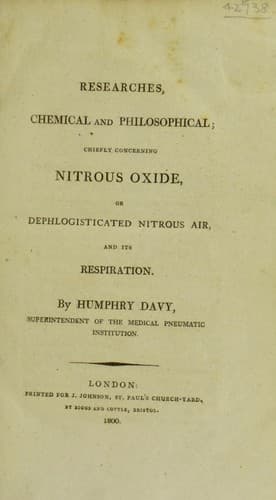
Researches Chemical and Philosophical; Chiefly concerning nitrous oxide: or dephlogisticated nitrous air and its respirationDavy, Humphry, Sir
Science
Researches Chemical and Philosophical; Chiefly concerning nitrous oxide: or dephlogisticated nitrous air and its respiration
Davy, Humphry, Sir
Nitrous oxide
_b._ Spring water boiled for some hours, and suffered to cool under
mercury, absorbed a quantity of nitrous gas equal to one thirteenth of
its bulk; which is not much less than that absorbed by pure water.
_c._ I exposed to spring water, 10 measures of nitrous gas; the
composition of which had been accurately ascertained; the diminution
was one twenty-eighth, the volume of water being taken as unity. On
placing the residuum in contact with solution of sulphate of iron,
the nitrogene remaining was nearly one twentieth more than had been
contained by the gas before its exposure to water.
_d._ Distilled water was saturated with common air, by being agitated
for some time in the atmosphere. Nitrous gas placed in contact with
this water, underwent a diminution of ¹/₁₈; the volume of water being
unity. The gas remaining after the absorption contained about one
twenty-seventh nitrogene more than before.
_e._ Nitrous gas exposed to water combined with about one fourth of its
volume of carbonic acid, diminished to ¹/₃₂[112] nearly. The remainder
contained little or no superabundant nitrogene.
[112] The water still being unity.
From these observations it appears, that the different degrees of
diminution of nitrous gas by different kinds of water, may depend upon
various causes.
1. Less nitrous gas will be absorbed by water holding in solution
earthy salts, than by pure water; and in this case the diminution of
the attraction of water for nitrous gas will probably be in the ratio
of the quantities of salt combined with it. _a._ _b._
2. The apparent diminution of nitrous gas in water, holding in solution
atmospheric air, will be less than in pure water, though the absolute
diminution will be greater; for the same portion will be absorbed,
whilst another portion is combined with the oxygene of the atmospheric
air contained in the water; and from the disengagement of the nitrogene
of this air, arises an increased residuum. _c._ _d._
3. Probably in waters containing nitrogene, hydrogene, and other gases,
absorbable only to a slight extent, the apparent diminution will be
less, on account of the disengagement of those gases from the water, by
the stronger affinity of nitrous gas for that fluid.
4. In water containing carbonic acid, and probably some other acid
gases, the diminution will be small in proportion to the quantity of
gas contained in the water: the affinity of this fluid for nitrous gas
being diminished by its greater affinity for the substance combined
with it. _e._
Public-domain text, read in full here on John Shaqi.
Reviews
Reviews
No reviews yet
Be the first to share your thoughts on this work.
Elsewhere in the archive
Join the Discussion
Join the discussion
Sign in to leave a comment or review.
Sign InorCreate an account