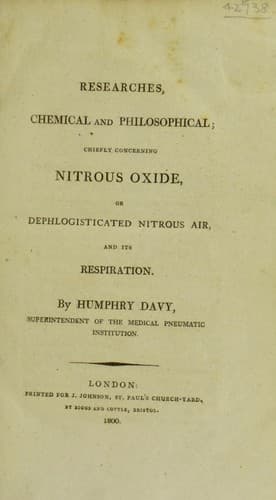
Researches Chemical and Philosophical; Chiefly concerning nitrous oxide: or dephlogisticated nitrous air and its respirationDavy, Humphry, Sir
Science
Researches Chemical and Philosophical; Chiefly concerning nitrous oxide: or dephlogisticated nitrous air and its respiration
Davy, Humphry, Sir
Nitrous oxide
The different diminution of nitrous gas when agitated in different
kinds of water, has been long observed by experimenters on the
constituent parts of the atmosphere, and various solutions have been
given of the phænomenon; the most singular is that of Humbolt.[113] He
supposes that the apparent diminution of nitrous gas is less in spring
water than distilled water, on account of the decomposition of the
carbonate of lime contained in the spring water, by the nitrous acid
formed from the contact of nitrous gas with the water; the carbonic
acid disengaged from this decomposition increasing the residuum.
[113] He says “100 parties de gaz nitreux, (à 0.14 d’azote) secouées
avec l’eau distillée, récemment cuite, diminuent en volume de 0.11, ou
0.12. Ce même gaz, en contact avec l’eau de puits, ne perd que 0.02. La
cause de cette différence de 0.9, ou 0.10, ne doit pas être attribuée
ni à l’impurité de l’air atmosphérique, contenu dans les interstices
de l’eau, ni à la décomposition de cette eau même. Elle n’est
qu’apparente; car l’acide nitrique, qui se forme par le contact du gaz
nitreux avec l’eau de puits, en décompose le carbonate de chaux. Il se
dégage de l’acide carbonique, qui, en augmentant le volume du residu,
rend l’absorption du gaz nitreux moins sensible. Pour déterminer la
quantité de cet acide carbonique, je lavai le résidu avec de l’eau de
chaux. Dans un grand nombre d’expériences, le volume diminua de 0.09,
ou 0.07. Il faut en conduire que l’eau de puits absorbe réellement 9 +
2, ou 7 + 2 parties de gas nitreux, c’est-à-dire, à peu-près la même
quantité que l’eau distillée.”
Annales De Chimie, xxviii. pag. 154.
This opinion may be confuted without even reference to my
observations. It is, indeed, altogether unworthy of a philosopher,
generally acute and ingenious. He seems to have forgotten that carbonic
acid is absorbable by water.
VII. _Of the absorption of Nitrous Gas, by solution of pale green
Sulphate of Iron._
_a._ The discovery of the exact difference between the sulphates of
iron, is owing to Proust.[114] According to the ingenious researches of
this chemist, there exist two varieties of sulphate of iron, the green
and the red. The oxide in the green sulphate contains ²⁷/₁₀₀ oxygen.
This salt, when pure, is insoluble in spirit of wine; its solution in
water is of a pale green color; it is not altered by the gallic acid,
and affords a white precipitate with alkaline prussiates.
[114] Nicholson’s Phil. Jour. No. 1, p. 453.
The red sulphate of iron is soluble in alcohol and uncrystalizable; its
oxide contains ⁴⁸/₁₀₀ oxygene. It forms a black precipitate with the
gallic acid, and with the alkaline prussiates, a blue one.
The common sulphates of iron generally consist of combinations of these
two varieties in different proportions.
Public-domain text, read in full here on John Shaqi.
Reviews
Reviews
No reviews yet
Be the first to share your thoughts on this work.
Elsewhere in the archive
Join the Discussion
Join the discussion
Sign in to leave a comment or review.
Sign InorCreate an account