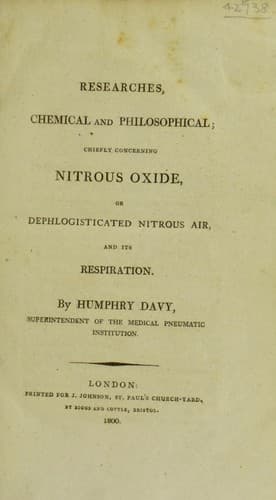
Researches Chemical and Philosophical; Chiefly concerning nitrous oxide: or dephlogisticated nitrous air and its respirationDavy, Humphry, Sir
Science
Researches Chemical and Philosophical; Chiefly concerning nitrous oxide: or dephlogisticated nitrous air and its respiration
Davy, Humphry, Sir
Nitrous oxide
The green sulphate may be converted into the red by oxygenated muriatic
acid or nitric acid. The common sulphate may be converted into green
sulphate, by agitation in contact with sulphurated hydrogene.
The green sulphate has a strong affinity for oxygene, it attracts it
from the atmosphere, from oxygenated marine acid, and nitric acid. The
alkalies precipitate from it a pale green oxide, which if exposed to
the atmosphere, rapidly becomes yellow red.
The red sulphate of iron has no affinity for oxygene, and when
decomposed by the alkalies, gives a red precipitate, which undergoes no
alteration when exposed to the atmosphere.[115]
[115] I have been able to make these observations on the sulphates of
iron, most of them after Proust.
_b._ The absorption of nitrous gas by a solution of sulphate of iron,
was long ago discovered by Priestley. During this absorption, he
remarked a change of color in the solution, analogous to that produced
by the mixture of it with nitric acid.
This chemical fact has been lately applied by Humbolt, to the discovery
of the nitrogene generally mingled with nitrous gas.
Vauquelin and Humbolt have published a memoir, on the causes of the
absorption[116] of nitrous gas by solution of sulphate of iron. They
saturated an ounce and half of sulphate of iron in solution, with 180
cubic inches of nitrous gas.
[116] Annales de Chimie, vol. xxviii. pag. 182.
Thus impregnated it strongly reddened tincture of turnsoyle; when
mingled with sulphuric acid, gave nitric acid vapor; and saturated with
potash, ammoniacal vapor.
By analysis, it produced as much ammoniac as that contained in 4 grains
of ammoniacal muriate, and a quantity of nitric acid equal to that
existing in 17 grains of nitre. Hence they concluded, that the nitrous
gas and a portion of the water of the solution, had mutually decomposed
each other; the oxygene of the water combining with the oxygene and a
portion of the nitrogene of nitrous gas to form nitric acid; and its
hydrogene uniting with the remaining nitrogene, to generate ammoniac.
They have taken no notice of the nature of the sulphate of iron
employed, which was most probably the common or mixed sulphate; nor of
the attraction of the oxide of iron in this substance for oxygene.
_c._ Before I was acquainted with the observations of Proust, the
common facts relating to the oxygenation of vitriol of iron induced
me to suppose, that the attraction of this substance for oxygene was
in some way connected with the process of absorption. The comparison
of the experiments of Humbolt and Vauquelin, with the observations of
Proust, enabled me to discover the true nature of the process.
Public-domain text, read in full here on John Shaqi.
Reviews
Reviews
No reviews yet
Be the first to share your thoughts on this work.
Elsewhere in the archive
Join the Discussion
Join the discussion
Sign in to leave a comment or review.
Sign InorCreate an account