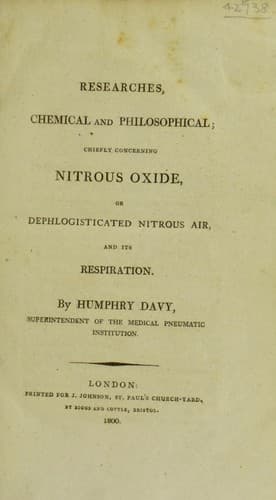
Researches Chemical and Philosophical; Chiefly concerning nitrous oxide: or dephlogisticated nitrous air and its respirationDavy, Humphry, Sir
Science
Researches Chemical and Philosophical; Chiefly concerning nitrous oxide: or dephlogisticated nitrous air and its respiration
Davy, Humphry, Sir
Nitrous oxide
I procured a solution of red sulphate of iron, by passing oxygenated
muriatic acid through a solution of common sulphate of iron, till it
gave only a red precipitate, when mingled with caustic potash. To
nitrous gas confined by mercury, a small quantity of this solution was
introduced. On agitation, its color altered to muddy green; but the
absorption that took place was extremely trifling: in half an hour it
did not amount to,2, the volume of the solution being unity, when it
had nearly regained the yellow color.
I now obtained a solution of green sulphate of iron, by dissolving iron
filings in diluted sulphuric acid. The solution was agitated in contact
with sulphurated hydrogene, and afterwards boiled; when it gave a white
precipitate with prussiate of potash.
A small quantity of this solution agitated in nitrous gas, quickly
became of an olive brown, and the gas was diminished with great
rapidity; in two minutes, a quantity equal to four times the volume of
the solution, had been absorbed.
These facts convinced me that the solubility of nitrous gas in common
sulphate of iron, chiefly depended upon the pale green sulphate
contained by it; and that the attraction of one of the constituents of
this substance, the green oxide of iron, for oxygene, was one of the
causes of the phænomenon.
_d._ Green sulphate of iron rapidly decomposes nitric acid. It was
consequently difficult to conceive how any affinities existing between
nitrous gas, water, and green sulphate of iron, could produce the
nitric acid found in the experiments of Vauquelin and Humbolt.
To ascertain if the presence of a great quantity of water destroyed the
power of green sulphate of iron to decompose nitric acid, I introduced
into a cubic inch of solution of green sulphate of iron, two drops of
concentrated nitric acid.
The solution assumed a very light olive color; prussiate of potash
mingled with a little of it, gave a dark green precipitate. Hence
the nitric acid had been evidently decomposed. As no nitrous gas was
given out, which is always the case when nitric acid is poured on
crystalised sulphate of iron, I suspected that a compleat decomposition
of the acid had taken place; but when the solution was heated, a few
minute globules of gas were liberated, and it gradually became slightly
clouded.
Having often remarked that no precipitation is ever produced during the
conversion of green sulphate of iron into red, by oxygenated muriatic
acid, or concentrated nitric acid, I could refer the cloudiness to no
other cause than to the formation of ammoniac.
To ascertain if this substance had been produced, a quantity of slacked
caustic lime was thrown into the solution. On the application of heat,
the ammoniacal smell was distinctly perceptible, and the vapor held
over orange nitrous acid, gave dense white fumes.
Public-domain text, read in full here on John Shaqi.
Reviews
Reviews
No reviews yet
Be the first to share your thoughts on this work.
Elsewhere in the archive
Join the Discussion
Join the discussion
Sign in to leave a comment or review.
Sign InorCreate an account