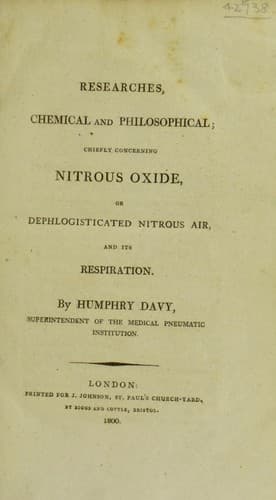
Researches Chemical and Philosophical; Chiefly concerning nitrous oxide: or dephlogisticated nitrous air and its respirationDavy, Humphry, Sir
Science
Researches Chemical and Philosophical; Chiefly concerning nitrous oxide: or dephlogisticated nitrous air and its respiration
Davy, Humphry, Sir
Nitrous oxide
_e._ When I considered this fact of the decomposition of nitric acid
and water by the solution of green sulphate of iron, and the change
of color effected in it by the absorption of nitrous gas, exactly
analogous to that produced by the decomposition of nitric acid; I
was induced to believe that the nitric acid found in the analysis of
Vauquelin and Humbolt, had been formed by the combination of some
of the nitrous gas thrown into the solution with the oxygene of the
atmosphere: and that the absorbability of nitrous gas, by solution of
green sulphate of iron, was owing to a decomposition produced by the
combination of its oxygene with the green oxide of iron, and of its
nitrogene with the hydrogene disengaged from water, decompounded at the
same time.
To ascertain this, I procured a quantity of nitrous gas: it was
suffered to remain in contact with water for some hours after its
production. Transferred to the mercurial apparatus, it gave no
white vapor when placed in contact with solution of ammoniac; and
consequently held no nitric acid in solution.
Into a graduated jar filled with mercury, a cubic inch of concentrated
solution of pure green sulphate of iron was introduced, and 7 cubic
inches of nitrous gas admitted to it. The solution immediately became
dark olive at the edges, and on agitation this color was diffused
through it. In 3 minutes, when near 5¾ cubic inches had been absorbed,
the diminution ceased. The solution was now of a bright olive brown,
and transparent at the edges. After it had rested for a quarter of an
hour, no farther absorption was observed; the color was the same, and
no precipitation could be perceived. A little of it was thrown into a
small glass tube, under the mercury, and examined in the atmosphere.
Its taste was rather more astringent than that of solution of green
sulphate; it did not at all alter the color of red cabbage juice. When
a little of it was poured on the mercury, it soon lost its color, its
taste became acid, and it quickly reddened cabbage juice, even rendered
green by an alkali.
To the solution remaining in the mercurial jar, a small quantity of
prussiate of potash was introduced, to ascertain if any red sulphate of
iron had been formed; but instead of the production of either a blue,
or a white precipitate, the whole of the solution became opaque, and
chocolate colored.
Surprised at this appearance, I was at first induced to suppose,
that the ammoniac formed by the nitrogene of the nitrous gas and the
hydrogene of the water, had been sufficient to precipitate from the
sulphuric acid, the red oxide of iron produced, and that the color of
the mixture was owing to this precipitation. To dissolve any uncombined
oxide that might exist in the solution, I added a very minute quantity
of diluted sulphuric acid; but little alteration of color was produced.
Hence, evidently, no red oxide had been formed.
Public-domain text, read in full here on John Shaqi.
Reviews
Reviews
No reviews yet
Be the first to share your thoughts on this work.
Elsewhere in the archive
Join the Discussion
Join the discussion
Sign in to leave a comment or review.
Sign InorCreate an account