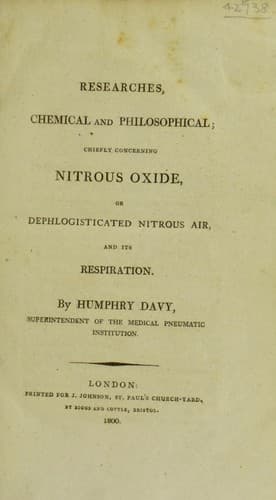
Researches Chemical and Philosophical; Chiefly concerning nitrous oxide: or dephlogisticated nitrous air and its respirationDavy, Humphry, Sir
Science
Researches Chemical and Philosophical; Chiefly concerning nitrous oxide: or dephlogisticated nitrous air and its respiration
Davy, Humphry, Sir
Nitrous oxide
This unexpected result obliged me to theorise a second time,
by supposing that nitrate of ammoniac had been produced, which
by combining with the white prussiate of iron, generated a new
combination. But on mingling together green sulphate of iron, prussiate
of potash, and nitrate of ammoniac in the atmosphere, the mixture
remained perfectly white.
To ascertain if any nitric acid existed, combined with any of the
bases, in the impregnated solution, I introduced into it an equal bulk
of diluted sulphuric acid: it became rather paler; but no green or blue
tinge was produced.
That the prussic acid had not been decomposed, was evident from the
bright green produced, when less than a grain of dilute nitric acid was
admitted into the solution.
_f._ From these experiments it was evident, that no red sulphate of
iron, or nitric acid, and consequently no ammoniac, had been produced
after the absorption of nitrous gas by green sulphate of iron. And when
I compared them with the observations of Priestley, who had expelled
by heat a minute quantity of nitrous gas from an impregnated solution
of common sulphate of iron, and who found common air phlogisticated by
standing in contact with it, I began to suspect that nitrous gas was
simply dissolved in the solution, without undergoing decomposition.
_g._ To determine more accurately the nature of the process, I
introduced into a mercurial cylinder 410 grains of solution of green
sulphate of iron, occupying a space nearly equal to a cubic inch and
quarter; it was saturated with nitrous gas, by absorbing 8 cubic
inches. This saturated solution exhibited the same appearance as
the last; and after remaining near an hour untouched, had evidently
deposited no oxide of iron, nor gained any acid properties.
Into a small mattrass filled with mercury, having a tight stopper
with a curved tube adapted to it, the greater part of this solution
was introduced; judging from the capacity of the mattrass, about 50
grains of it might have been lost. To prevent common air from coming in
contact with the solution, the stopper was introduced into the mattrass
under the mercury; the curved tube connected with a graduated cylinder
filled with that substance; and the mattrass brought over the side of
the mercurial trough. But in spite of these precautions a large globule
of common air got into the top of the mattrass, from the curvature of
the tube. When the heat of a spirit lamp was applied to the solution,
it gave out gas with great rapidity, and gradually lost its color.
When 5 cubic inches were collected it became perfectly pale green,
whilst a yellow red precipitate was deposited on the bottom of the
mattrass.
On pouring a little of the clear solution into prussiate of potash, it
gave only white prussiate of iron.
Public-domain text, read in full here on John Shaqi.
Reviews
Reviews
No reviews yet
Be the first to share your thoughts on this work.
Elsewhere in the archive
Join the Discussion
Join the discussion
Sign in to leave a comment or review.
Sign InorCreate an account