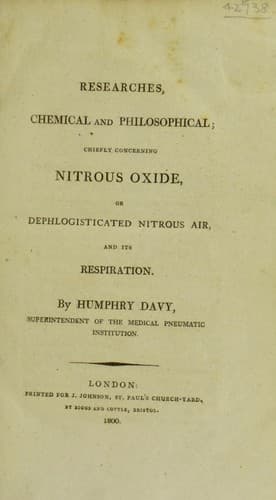
Researches Chemical and Philosophical; Chiefly concerning nitrous oxide: or dephlogisticated nitrous air and its respirationDavy, Humphry, Sir
Science
Researches Chemical and Philosophical; Chiefly concerning nitrous oxide: or dephlogisticated nitrous air and its respiration
Davy, Humphry, Sir
Nitrous oxide
But on introducing a particle of sulphuric acid into the solution,
sufficient to dissolve some of the red precipitate, and then pouring
a little of it into a solution of prussiate of potash, it gave a fine
blue prussiate of iron.
Hence the red precipitate was evidently red yellow oxide of iron.
I now examined the gas, suspecting that it was nitrous oxide. On
mingling a little of it with atmospheric air, it gave red vapor, and
diminished. Solution of sulphate of iron introduced to the remainder,
almost wholly absorbed it: the small residual globule of nitrogene
could not equal one thirtieth of a cubic inch.
Consequently it was nitrous gas, nearly pure.
Caustic potash was now introduced into the solution, till all the oxide
of iron was precipitated. The solution, when heated, gave a strong
smell of ammoniac, and dense white fumes when held over muriatic acid.
It was kept at the heat of ebullition till the evaporation had been
nearly compleated. Sulphuric acid poured upon the residuum gave no
yellow fumes, or nitric acid vapor in any way perceptible; even when
heated and made to boil, there was no indication of the production of
any vapor, except that of the sulphuric acid.
_h._ This experiment, compared with the others, seemed almost to prove,
that nitrous gas combined with solution of pale green sulphate of
iron, at the common temperature, without decomposition; and that when
the impregnated solution was heated, the greater portion of gas was
disengaged, whilst the remainder was decompounded by the green oxide of
iron; which attracted at the same time oxygene from the water and the
nitrous gas; whilst their other constituent principles, hydrogene and
nitrogene, entered into union as ammoniac.
Whilst, however, I was reasoning upon this singular chemical change,
as affording presumptive proofs in favor of the exertion of simple
affinities by the constituent parts of compound substances, a doubt
concerning the decomposition of the nitrous gas occurred to me. As
near as I could guess at the quantity of nitrous gas contained by
the impregnated solution, at least ¾ of it must have been expelled
undecompounded.
More than a quarter of a cubic inch of common air had been present in
the mattrass: the oxygene of this common air must have combined with
the nitrous gas, to form nitric acid. Might not this nitric acid have
been decomposed, and furnished oxygene to the red oxide of iron, and
nitrogene to the small quantity of ammoniac found in the solution, as
in _d_?
_i._ I now introduced to a solution of green sulphate confined by
mercury, nitrous gas, perfectly free from nitric acid. When the
solution was saturated, a portion of it was introduced into a small
mattrass filled with dry mercury, in the mercurial trough. The curved
tube was closed by a small cork at the top, and filled with nitrous
gas; it was then adapted to the mattrass, which was raised from the
trough, and the solution thus effectually preserved from the contact of
the atmosphere.
Public-domain text, read in full here on John Shaqi.
Reviews
Reviews
No reviews yet
Be the first to share your thoughts on this work.
Elsewhere in the archive
Join the Discussion
Join the discussion
Sign in to leave a comment or review.
Sign InorCreate an account