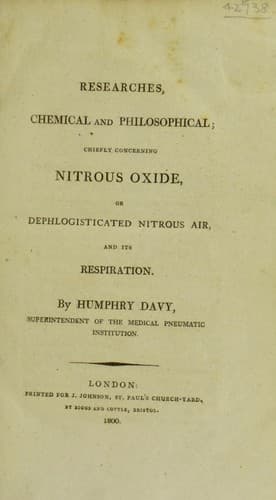
Researches Chemical and Philosophical; Chiefly concerning nitrous oxide: or dephlogisticated nitrous air and its respirationDavy, Humphry, Sir
Science
Researches Chemical and Philosophical; Chiefly concerning nitrous oxide: or dephlogisticated nitrous air and its respiration
Davy, Humphry, Sir
Nitrous oxide
When the heat of a spirit lamp was applied to the mattrass, it began to
give out gas with great rapidity. After some time the solution lost its
dark color, and became turbid. When the production of nitrous gas had
ceased, it was suffered to cool. A copious red precipitate had fallen
down; which, examined by the same tests as in the last experiment,
proved to be red oxide of iron.
The solution treated with lime, as before, gave ammoniac; but with
sulphuric acid, not the slightest indications of nitric acid.
_k._ Having thus procured full evidence of the decomposition of
nitrous gas in the heated solution, in order to gain a more accurate
acquaintance with the affinities exerted, I endeavoured to ascertain
the quantity of nitrous gas decomposed by a given solution, under known
circumstances.
Into a cylinder of the capacity of 20 cubic inches, inverted in
mercury, 1150 grains of solution of green sulphate of iron, of specific
gravity 1,4, were introduced. Nitrous gas was admitted to it, and after
some time 21 cubic inches were absorbed.
The impregnated solution was thrown into a mattrass, in the same manner
as in the last experiment, and the same precautions taken to preserve
it from the contact of atmospheric air. A quantity was lost during
the process of transferring, which, reasoning from the space occupied
in the mattrass by the remaining portion, as determined by experiment
afterwards, must have amounted nearly to 240 grains.
The curved tube from the mattrass was now made to communicate with
the mercurial airholder. By the application of heat 12,5 cubic inches
of nitrous gas were collected, after the common temperature had been
restored to the mattrass; which was suffered to remain in communication
with the conducting tube.
The solution was now pale green, that is, of its natural color, and a
considerable quantity of red oxide of iron had been deposited.
Solid caustic potash was introduced into it, till all the green oxide
of iron had been precipitated, and till the solution rendered green,
red cabbage juice.
A tube was now accurately connected with the mattrass, bent, and
introduced into a small quantity of diluted sulphuric acid. Nearly half
of the fluid in it was slowly distilled into the sulphuric acid, by
the heat of a spirit lamp. The impregnated acid evaporated at a heat
above 212°, and gave a small quantity of crystalised salt, which barely
amounted to two grains and quarter: it had every property of sulphate
of ammoniac. Sulphuric acid in excess was poured on the residuum, and
the whole distilled by a heat not exceeding 300°, into a small quantity
of water. This water, after the process, tasted strongly of sulphuric
acid; it had no peculiar odor. Tin thrown into it when heated, was not
perceptibly oxydated; mingled with strontitic lime water, it gave a
copious white precipitate, and after the precipitation became almost
tasteless. Hence it evidently contained no nitric acid.
Public-domain text, read in full here on John Shaqi.
Reviews
Reviews
No reviews yet
Be the first to share your thoughts on this work.
Elsewhere in the archive
Join the Discussion
Join the discussion
Sign in to leave a comment or review.
Sign InorCreate an account