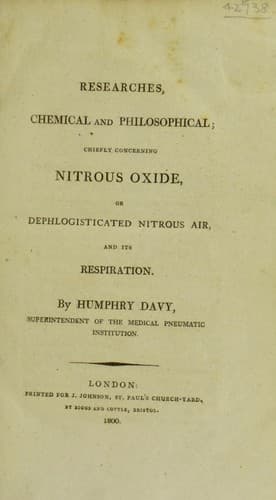
Researches Chemical and Philosophical; Chiefly concerning nitrous oxide: or dephlogisticated nitrous air and its respirationDavy, Humphry, Sir
Science
Researches Chemical and Philosophical; Chiefly concerning nitrous oxide: or dephlogisticated nitrous air and its respiration
Davy, Humphry, Sir
Nitrous oxide
The 12,5 cubic inches of undecompounded gas that came over were
examined; and accounting for the small quantity of common air
previously contained in the airholder, must have been almost pure.
_l._ Now supposing 927 grains of the impregnated solution (including
the weight of the nitrous gas), to have been operated upon, this must
have contained about 16,7 cubic inches of nitrous gas. But 12,5 cubic
inches escaped undecompounded: hence 4,2 were decomposed; and these
weigh 1,44 grains, and are composed of,8 oxygene, and,64 nitrogene.[117]
Consequently, the nitrous gas must have furnished,8 of oxygene to the
green oxide of iron.
But,64 of nitrogene require,15 of hydrogene to form,79 of
ammoniac:[118] consequently 1 of water was decompounded, and this
furnished,85 of oxygene to the green oxide of iron.
[117] Division IV. Section 5.
[118] Division II. Section 1.
The green oxide of iron contains ²⁷/₁₀₀ oxygene; the red ⁴⁸/₁₀₀. But
the whole quantity of oxygene supplied from the water and nitrous
gas is 0,8 + 0,85 = 1,65; and calculating on the difference of the
composition of the red and green oxide of iron, 5,7 grains of red oxide
must have been deposited, and consequently these would saturate as
much acid as,79 grains of ammoniac, or 4,1 grains of green oxide of
iron.[119]
And supposing the ammoniac in sulphate of ammoniac to be to the acid
as 1 is to 3,[120] 3.2 grains of sulphate of ammoniac must have been
formed, containing about 2,4 grains acid; and then 6,5 grains of green
sulphate of iron must have been decomposed.
[119] No precipitation takes place during the conversion of solution of
green sulphate into red; and the acid appears saturated.
[120] Division II, Section 6.
Hence we gain the following equation:
6,5 green s. = 2,41 sul. acid + 4,1 gr. ox. iron.
+
1,44 nit. gas = ,64 nitrogene + ,8 oxygene.
+
1 water = ,85 oxygene, + ,15 hydrogene,
equal
3,2 sul. am. = 2,41 s. acid + ,64 nit. + ,15 hyd.
+
5,7 r. ox. iron = 4,1 gr. ox. iron + 1,6 oxyg.
Though the estimation of the quantities in this equation must not
be considered as strictly accurate, on account of the degree of
uncertainty that remains concerning the exact numerical expression of
the quantities of the constituents of water, ammoniac, and the other
compound bodies employed; yet as founded on a simple quantity, that is,
the nitrous gas decomposed, it cannot be very distant from the truth.
The sulphate of ammoniac given by experiment, is considerably less than
that which was really produced; much of it was probably carried off
during the evaporation of the superabundant acid.
Public-domain text, read in full here on John Shaqi.
Reviews
Reviews
No reviews yet
Be the first to share your thoughts on this work.
Elsewhere in the archive
Join the Discussion
Join the discussion
Sign in to leave a comment or review.
Sign InorCreate an account