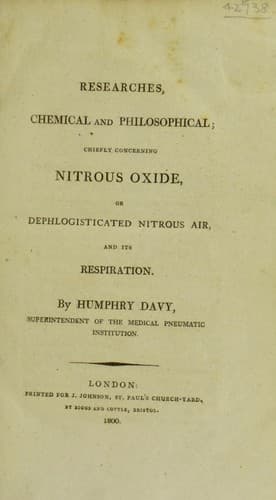
Researches Chemical and Philosophical; Chiefly concerning nitrous oxide: or dephlogisticated nitrous air and its respirationDavy, Humphry, Sir
Science
Researches Chemical and Philosophical; Chiefly concerning nitrous oxide: or dephlogisticated nitrous air and its respiration
Davy, Humphry, Sir
Nitrous oxide
The conclusions that may be drawn from this experiment, afford a
striking instance of the importance of the application of the science
of quantity to the chemical changes: for the data being one chemical
fact, the decomposition of a given quantity of nitrous gas by known
agents; the composition of nitrous gas, of water, ammoniac, the oxides
of iron, and sulphate of ammoniac; we are able not only to determine
the quantities of the simple constituents that have entered into new
arrangements, but likewise the composition of two compound bodies, the
green and red sulphates of iron.[121]
[121] According to the estimation in the equation, 6.5 of dry green
sulphate of iron contain 4.1 green oxide of iron, and 2.4 of Kirwan’s
real sulphuric acid; and 8.1 red sulphate of iron, contain 2.4 acid,
and 5.7 red oxide of iron.
_m._ Though from the experiments in _e_ it appeared that no
decomposition of nitrous gas had been produced during or even after its
absorption by solution of sulphate of iron at the common temperature;
yet a suspicion that it might take place slowly, and that indications
of it might be given by deposition, induced me to examine minutely
two impregnated solutions, one of which had been at rest, confined by
mercury, for 19 hours, and the other for 27. In neither of them could I
discover any deposition, or alteration of color, which might denote a
change.
Two cubic inches of oxygene were admitted to half a cubic inch of one
of these solutions. The oxygene was slowly absorbed, and the solution
gradually lost its color.
To ascertain if during the conversion of the nitrous gas held in
solution by sulphate of iron, into nitric acid, by the oxygene of the
atmosphere at the common temperature, any water was decomposed; I
suffered an impregnated solution, weighing nearly two ounces, to remain
in contact with the atmosphere at 57°-62°, till it was become perfectly
pale. It then had a strong acid taste, effervesced with carbonate
of potash, and gave a blue precipitate with prussiate of potash.—It
was saturated with quicklime, and heated: slight indications of the
presence of ammoniac were perceived.
As in this experiment the nitric acid had been most probably decomposed
by the green oxide of iron, as in _f_, I sent oxygenated muriatic acid
through an impregnated solution, till all the green oxide of iron was
converted into red, and all the nitrous gas into nitric acid.
This solution saturated with potash, and heated, gave no ammoniacal
smell.
From these experiments we may conclude,
1st. That solution of red sulphate of iron has little or no affinity
for nitrous gas[122]; and that solution of common sulphate absorbs
nitrous gas only in proportion as it contains green sulphate.
[122] The muddy green color produced in a solution of red sulphate of
iron agitated in nitrous gas, depended upon impurities in the mercury.
I have since found, that when the solution is completely oxygenated,
the diminution is barely perceptible.
Public-domain text, read in full here on John Shaqi.
Reviews
Reviews
No reviews yet
Be the first to share your thoughts on this work.
Elsewhere in the archive
Join the Discussion
Join the discussion
Sign in to leave a comment or review.
Sign InorCreate an account