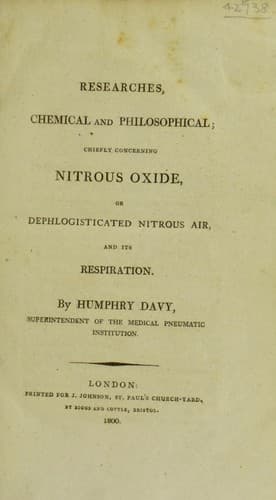
Researches Chemical and Philosophical; Chiefly concerning nitrous oxide: or dephlogisticated nitrous air and its respirationDavy, Humphry, Sir
Science
Researches Chemical and Philosophical; Chiefly concerning nitrous oxide: or dephlogisticated nitrous air and its respiration
Davy, Humphry, Sir
Nitrous oxide
2dly. That solutions of green sulphate of iron dissolve nitrous gas in
quantities proportionable to their concentration, without effecting
any decomposition of it at common temperatures. And the solubility
of nitrous gas in solution of green sulphate, may be supposed to
depend on an equilibrium of affinity, produced by the following simple
attractions:
1. That of green oxide of iron for the oxygene
of nitrous gas and water.
2. That of the hydrogene of the water
for the nitrogene of the nitrous gas.
3. That of the principles of the sulphuric
acid, for nitrogene and hydrogene.
3dly. That at high temperatures, that is, from 200° to 300°, the
equilibrium of affinity producing the binary combination between
nitrous gas and solution of green sulphate of iron is destroyed; the
attraction of the green oxide of iron for oxygene being increased;
whilst probably that of nitrogene for hydrogene is diminished.
Hence the nitrous gas is either liberated,[123] in consequence of the
affinity between oxygene and hydrogene, and oxygene and nitrogene not
following the same ratio of alteration on increased temperature; or
decomposed, because at a certain temperature the green oxide exerts
such affinities upon water and nitrous gas, as to attract oxygene from
both of them to form red oxide; whilst the still existing affinity
between the hydrogene of the one, and the nitrogene of the other,
disposes them to combine to form ammoniac.
[123] Perhaps the liberation of nitrous gas from the solution takes
place at a lower temperature than its decomposition. I have always
observed that the quantity of yellow precipitate is greater when the
solution is rapidly made to boil. Were it possible to heat it to a
certain temperature at once, probably a compleat decomposition would
take place.
4thly. That the change of color produced by introducing nitric acid
to solution of common sulphate of iron, exactly analogous to that
occasioned in it by impregnation with nitrous gas, is owing to the
decomposition of the acid, by the combination of its oxygene with the
green oxide of iron, and of its nitrous gas with the solution.
5thly. That nitrous gas in combination with solution of green sulphate
of iron, is capable of exerting a strong affinity upon free or loosely
combined oxygene, and of uniting with it to form nitric acid.
_n._ The products obtained from a solution of sulphate of iron
saturated with nitrous gas, by Vauquelin and Humbolt, and their
consequent mistake with regard to the nature of the process of
absorption,[124] must have arisen from exposure of their impregnated
solution to the atmosphere.
[124] Annales de Chimie. T. 38, pag. 187.
Public-domain text, read in full here on John Shaqi.
Reviews
Reviews
No reviews yet
Be the first to share your thoughts on this work.
Elsewhere in the archive
Join the Discussion
Join the discussion
Sign in to leave a comment or review.
Sign InorCreate an account