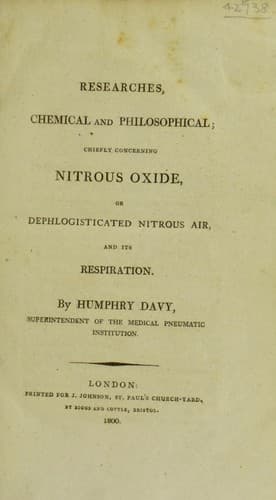
Researches Chemical and Philosophical; Chiefly concerning nitrous oxide: or dephlogisticated nitrous air and its respirationDavy, Humphry, Sir
Science
Researches Chemical and Philosophical; Chiefly concerning nitrous oxide: or dephlogisticated nitrous air and its respiration
Davy, Humphry, Sir
Nitrous oxide
Indeed, from the acidity of it, on examination, from the small portion
of ammoniac, and the large quantity of nitric acid obtained, it appears
most probable that the whole of the nitrous gas employed was converted
into nitric acid, by combining with atmospheric oxygene; for no nitric
acid could have been obtained in the mode in which they operated,
unless the green oxide of iron in the solution had been previously
converted into red.
VIII. _On the absorption of Nitrous Gas by solution of green Muriate of
Iron._
_a._ The analogy between the affinities of the constituents of the
muriate and sulphate of iron, induced me to conjecture that they
possessed similar powers of absorbing nitrous gas; and I soon found
that this was actually the case; for on agitating half a cubic inch
of solution of muriated iron, procured by dissolving iron filings
in muriatic acid, in nitrous gas, the gas was absorbed with great
rapidity, whilst the solution assumed a deep and bright brown tinge.
_b._ Proust,[125] who as I have before mentioned, supposes the
existence of two oxides of iron only, one containing ²⁷/₁₀₀ oxygene,
the other ⁴⁸/₁₀₀, has assumed, that the muriatic acid, and most other
acids as well as the sulphuric, are capable of combining with these
oxides, and of forming with each of them a distinct salt. He has,
however, detailed no experiments on the muriates of iron.
[125] Annales de Chimie, xxiii. pag. 85; or Nicholson’s Phil. Journal
vol. i. pag. 45.
As these salts are still more distinct from each other in their
properties than the sulphates, and as these properties are connected
with the phænomenon of the absorption and decomposition of nitrous gas,
I shall detail the observations I have been able to make upon them.
_c._ When iron filings have been dissolved in pure muriatic acid, and
the solution preserved from the contact of air, it is of a pale green
color, and gives a white precipitate with alkaline prussiates. The
alkalies throw down from it a light green oxide of iron.
When evaporated, it gives crystals almost white, which are extremely
soluble in water; but insoluble in alcohol.
The solution of green muriate of iron has a great affinity for oxygene,
and attracts it from the atmosphere, from nitric acid, and probably
from oxygenated muriatic acid.
When red oxide of iron is dissolved in muriatic acid, or when nitric
acid is decomposed by solution of green muriate of iron; the red
muriate of iron is produced. The solution of this salt is of a deep
brown red, its odor is peculiar, and its taste, even in a very diluted
state, highly astringent. It acts upon animal and vegetable matters in
a manner somewhat analogous to the oxygenated muriatic acid, rendering
them yellowish white, or yellow.[126]
[126] Probably by giving them oxygene; whereas the green muriate and
sulphate blacken animal substances; most likely by abstracting from
them oxygene.
Public-domain text, read in full here on John Shaqi.
Reviews
Reviews
No reviews yet
Be the first to share your thoughts on this work.
Elsewhere in the archive
Join the Discussion
Join the discussion
Sign in to leave a comment or review.
Sign InorCreate an account