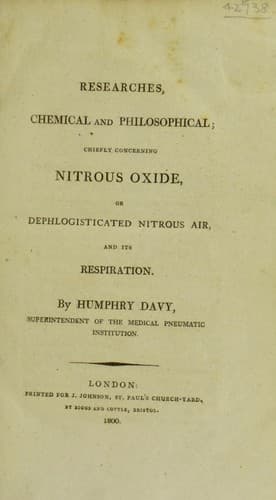
Researches Chemical and Philosophical; Chiefly concerning nitrous oxide: or dephlogisticated nitrous air and its respirationDavy, Humphry, Sir
Science
Researches Chemical and Philosophical; Chiefly concerning nitrous oxide: or dephlogisticated nitrous air and its respiration
Davy, Humphry, Sir
Nitrous oxide
Sulphuric acid poured upon it, produces a smell resembling that of
oxygenated muriatic acid. Evaporated at a low temperature, it gives an
uncrystalisable dark, orange colored salt, which is soluble in alcohol,
and when decomposed by the alkalies, gives a red precipitate. With
prussiate of potash it gives prussian blue.
The common muriate of iron consists of different proportions of these
two salts. It may be converted into red muriate by concentrated nitric
acid, or into green by sulphurated hydrogene.
_d._ To ascertain if solution of red muriate of iron was capable of
absorbing nitrous gas, I introduced into a jar filled with mercury, a
cubic inch of nitrous gas, and admitted to it nearly half a cubic inch
of solution of red muriate of iron. No discoloration took place. By
much agitation, however, an absorption of nearly,2 was produced, and
the solution became of a muddy green. But this change of color, and
probably the absorption, was in consequence of the oxydation of either
the mercury, or some imperfect metals combined with it, by the oxygene
of the red muriate. For I afterwards found, that precisely the same
change of color was produced when a solution was agitated over mercury.
_e._ I introduced to a cubic inch of concentrated solution of green
muriate of iron, 7 cubic inches of nitrous gas, free from nitric acid;
the solution instantly became colored at the edges, and on agitation
absorbed the gas with much greater rapidity than even sulphate of iron;
in a minute, only a quarter of a cubic inch remained.
The solution appeared of a very dark brown, but evidently no
precipitation had taken place in it, and the edges, when viewed against
the light, were transparent and puce colored.
Five cubic inches more of nitrous gas were now dissolved in the
solution. The intensity of the color increased, and after an hour no
deposition had taken place. A little of it was then examined in the
atmosphere; it had a much more astringent taste than the unimpregnated
solution, and effected no change in red cabbage juice. When prussiate
of potash was introduced into it, its color changed to olive brown. A
few drops of the solution, that had accidentally fallen on the mercury,
soon became colorless, and then effervesced with carbonate of potash,
and tasted strongly acid.
The remainder of the impregnated solution, which must have nearly
equalled,75 cubic inches, was introduced into a mattrass, having a
stopper and curved tube, as in the experiments on the solution of
sulphate of iron; great care being taken to preserve it from the
contact of air.
Public-domain text, read in full here on John Shaqi.
Reviews
Reviews
No reviews yet
Be the first to share your thoughts on this work.
Elsewhere in the archive
Join the Discussion
Join the discussion
Sign in to leave a comment or review.
Sign InorCreate an account