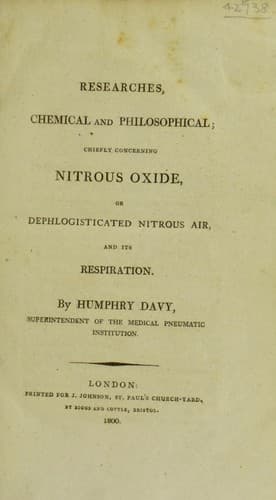
Researches Chemical and Philosophical; Chiefly concerning nitrous oxide: or dephlogisticated nitrous air and its respirationDavy, Humphry, Sir
Science
Researches Chemical and Philosophical; Chiefly concerning nitrous oxide: or dephlogisticated nitrous air and its respiration
Davy, Humphry, Sir
Nitrous oxide
The mattrass was heated by a spirit lamp, the curved tube being in
communication with a mercurial cylinder. Near 8 cubic inches of nitrous
gas were collected, when the solution became of a muddy yellow. It was
suffered to cool, and examined. A small quantity of yellow precipitate
covered the bottom of the mattrass; the fluid was pellucid, and
light green. A little of it thrown on prussiate of potash, gave a
white precipitate, colored by streaks of light blue. When the yellow
precipitate was partly dissolved by sulphuric acid, a drop of the
solution, mingled with prussiate of potash, gave a deep blue green.
Hence, evidently, the precipitate was red oxide of iron.
Caustic potash in excess was introduced into the remainder of the
solution, and it was heated. It gave an evident smell of ammoniac, and
dense white fumes, when held over strong phlogisticated nitrous acid.
When half of it was evaporated, sulphuric acid in excess was poured on
the remainder; muriatic acid was liberated, not perceptibly combined
with any nitric acid.
_f._ In an experiment that I made to ascertain the quantity of nitrous
gas capable of combining with solution of green muriate of iron; I
found that,75 cubic inches of saturated solution absorbed about 18
of nitrous gas, which is nearly double the quantity combinable with
an equal portion of the strongest solution of sulphate of iron. A
part of this impregnated solution, heated slowly, gave out more
gas in proportion to the quantity it contained, than the last, and
consequently produced less precipitate; so that I am inclined to
suppose it probable, that at a certain temperature, all the dissolved
nitrous gas may be dispelled from a solution.
From these experiments we may conclude,
1st. That the solution of green muriate of iron absorbs nitrous gas in
consequence of nearly the same affinities as solution of green sulphate
of iron; its capability of absorbing larger quantities depending
most probably on its greater concentration (that is, on the greater
solubility of the muriate of iron), and perhaps, in some measure, on a
new combining affinity, that of muriatic acid for oxygene.
2dly. That at certain temperatures nitrous gas is either liberated from
solution of green muriate, or decomposed, by the combination of its
oxygene with green oxide of iron, and of its nitrogene with hydrogene,
produced from water decompounded by the oxide at the same time.
IX. _Absorption of Nitrous Gas by Solution of Nitrate of Iron._
_a._ As well as two sulphates and two muriates of iron, there exist two
nitrates.[127] When concentrated nitric acid is made to act upon iron,
nitrous gas is disengaged with great rapidity, and with great increase
of temperature: the solution assumes a yellowish tinge, and as the
process goes on, a yellow red oxide is precipitated.
[127] The existence of green nitrate was not suspected by Proust.
Public-domain text, read in full here on John Shaqi.
Reviews
Reviews
No reviews yet
Be the first to share your thoughts on this work.
Elsewhere in the archive
Join the Discussion
Join the discussion
Sign in to leave a comment or review.
Sign InorCreate an account