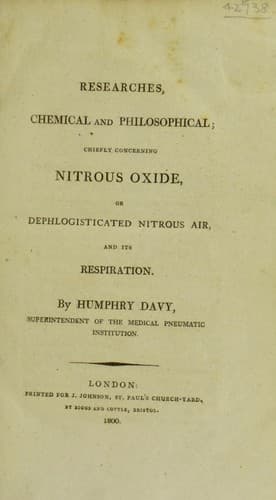
Researches Chemical and Philosophical; Chiefly concerning nitrous oxide: or dephlogisticated nitrous air and its respirationDavy, Humphry, Sir
Science
Researches Chemical and Philosophical; Chiefly concerning nitrous oxide: or dephlogisticated nitrous air and its respiration
Davy, Humphry, Sir
Nitrous oxide
Nitrate of iron made in this way, gives a bright blue mingled with
prussiate of potash, and decomposed by the alkalies, a red precipitate.
Its solution has little or no affinity for nitrous gas.
_b._ When very dilute nitric acid, that is, such as of specific gravity
1,16, is made to oxydate iron, without the assistance of heat, the
solution gives out no gas for some time, and becomes dark olive brown:
when neutralised it gives, decomposed by the alkalies, a light green
precipitate; and mingled with prussiate of potash, pale green prussiate
of iron.
It owes its color to the nitrous gas it holds in solution. By exposure
to the atmosphere it becomes pale, the nitrous gas combined with it
being converted into nitric acid.
It is then capable of absorbing nitrous gas, and consists of pale
nitrate of iron, mingled with red nitrate.
I have not yet obtained a nitrate of iron giving only a white
precipitate with prussiate of potash, that is, such as contains _only_
oxide of iron at its minimum of oxydation; for when pure green oxide
of iron is dissolved by very dilute nitric acid, a small quantity of
the acid is generally decomposed, which is likewise the case in the
decomposition of nitre by green sulphate of iron. The solutions of
nitrate of iron, however, procured in both of these modes, absorb
nitrous gas with rapidity, and by sulphurated hydrogene might probably
be converted into pale nitrate.
As it is impossible to obtain concentrated solutions of pale nitrate of
iron, chiefly containing green oxide, its powers of absorbing nitrous
gas cannot be compared with the muriatic and sulphuric solutions,
unless they are made of nearly the same specific gravity.
Nitrous gas is disengaged by heat from the impregnated solution of
nitrate of iron, at the same time that much red oxide of iron is
precipitated. Whether any nitrous gas is decomposed, I have not yet
ascertained; for when unimpregnated pale nitrate of iron is heated,
a part of the acid, and of the water of the solution, is decomposed
by the green oxide of iron;[128] and in consequence ammoniac, and red
nitrate of iron formed, whilst red oxide is precipitated.
[128] In this process nitrous oxide is sometimes given out, as will be
seen hereafter.
X. _Absorption of Nitrous Gas by other Metallic Solutions._
_a._ White prussiate of iron in contact with water absorbs nitrous gas
to a great extent, and becomes dark chocolate.[129]
_b._ Concentrated solution of sulphate of tin, _probably_ at its
minimum of oxydation, absorbs one eighth of its bulk of nitrous gas,
and becomes brown, without deposition.
_c._ Solution of sulphate of zinc absorbs about one tenth of its volume
of nitrous gas, and becomes green.
_d._ Solution of muriate of zinc[130] absorbs nearly the same quantity,
and becomes orange brown.
[129] Hence we learn why no nitrous gas is disengaged when impregnated
solution of sulphate of iron is decomposed by prussiate of potash, as
in Div. IV. Sec. vii.
Public-domain text, read in full here on John Shaqi.
Reviews
Reviews
No reviews yet
Be the first to share your thoughts on this work.
Elsewhere in the archive
Join the Discussion
Join the discussion
Sign in to leave a comment or review.
Sign InorCreate an account