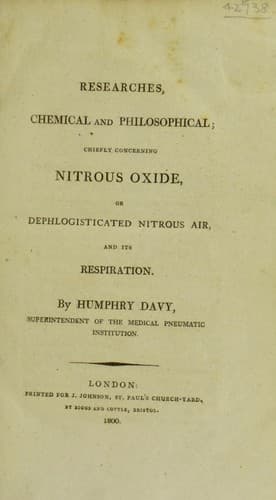
Researches Chemical and Philosophical; Chiefly concerning nitrous oxide: or dephlogisticated nitrous air and its respirationDavy, Humphry, Sir
Science
Researches Chemical and Philosophical; Chiefly concerning nitrous oxide: or dephlogisticated nitrous air and its respiration
Davy, Humphry, Sir
Nitrous oxide
[130] In both of these solutions the metal is at its minimum of
oxydation. The absorption of a small quantity of nitrous gas by white
vitriol was observed by Priestley.
_e._ These are all the metallic substances on which I have
experimented. It is more than probable that there exist others
possessing similar powers of absorbing nitrous gas.
Whenever the metals capable of decomposing water exist in solutions at
their minimum of oxydation, the affinities exerted by them on nitrous
gas and water, will be such as to produce combination. The powers of
metallic solutions to combine with nitrous gas at common temperatures,
as well as to decompose it at higher temperatures, will probably be
in the ratio of the affinity of the metallic oxides they contain, for
oxygene.
XI. _The action of Sulphurated Hydrogene on solution of Green Sulphate
of Iron, impregnated with Nitrous Gas._
_a._ In an experiment on the absorption of nitrous gas by solution of
green sulphate of iron, I introduced an unboiled solution of common
sulphate, deprived of red oxide of iron by sulphurated hydrogene, into
a jar filled with nitrous gas; the absorption took place as usual,
and nearly six of gas entered into combination, the volume of the
solution being unity. On applying heat to a part of this impregnated
solution, the whole of the nitrous gas it contained (as nearly as I
could guess), was expelled undecompounded, and no yellow precipitate
produced. Prussiate of potash poured into it gave only white prussiate
of iron; and when it was heated with lime, no ammoniacal smell was
perceptible.
I could refer this phænomenon to no other cause than to the existence
of a small quantity of sulphurated hydrogene in the solution. That this
was the real cause I found from the following experiment.
_b._ One part of a solution of green sulphate of iron, formed by the
agitation of common sulphate of iron in contact with sulphurated
hydrogene, was boiled for some minutes to expel the small quantity of
gas retained by it undecompounded. It had then no peculiar smell, and
gave a white prussiate of iron with prussiate of potash; the other
part had a faint odor of sulphurated hydrogene, and gave a dirty white
precipitate with prussiate of potash. Nearly equal quantities of each
were saturated with nitrous gas, and heated. The unboiled impregnated
solution gave out all its nitrous gas undecompounded; whilst in the
boiled solution it was partly decomposed, yellow precipitate and
ammoniac being formed.
_c._ This singular phænomenon of the power of a minute quantity of
sulphurated hydrogene, in preventing the decomposition of nitrous gas
and water, by green oxide of iron, will most probably take place in
other impregnated solutions. It seems to depend on the strong affinity
of the hydrogene of sulphurated hydrogene for oxygene.
XII. _Additional Observations._
Public-domain text, read in full here on John Shaqi.
Reviews
Reviews
No reviews yet
Be the first to share your thoughts on this work.
Elsewhere in the archive
Join the Discussion
Join the discussion
Sign in to leave a comment or review.
Sign InorCreate an account