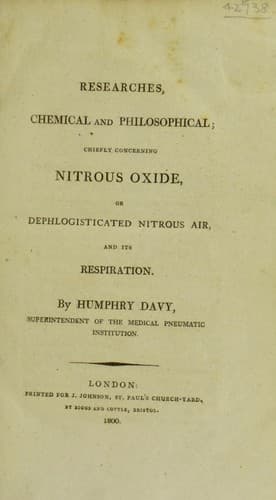
Researches Chemical and Philosophical; Chiefly concerning nitrous oxide: or dephlogisticated nitrous air and its respirationDavy, Humphry, Sir
Science
Researches Chemical and Philosophical; Chiefly concerning nitrous oxide: or dephlogisticated nitrous air and its respiration
Davy, Humphry, Sir
Nitrous oxide
_a._ For separating nitrous gas from gases absorbable to no great
extent by water; a well boiled solution of green muriate of iron
should be employed. Nitrous gas agitated in this is rapidly absorbed,
and it has no affinity for, or action on, nitrogene, hydrogene, or
hydrocarbonate.
_b._ Nitrous gas carefully obtained from mercury and nitric acid, when
received under mercury, or boiled water, and absorbed by solution of
green muriate, or sulphate of iron, rarely leaves a residuum of ¹/₂₀₀
of its volume: preserved over common water, and absorbed, the remainder
is generally from ¹/₄₀ to ¹/₉₀, from the nitrogene disengaged by the
decomposition of the common air contained in the water.
_c._ The nitrous gas carefully obtained from the decomposition of
nitric acid of 1,26, by copper, I have hardly ever found to contain
more than from ¹/₃₀ to ¹/₅₀ nitrogene, when received through common
water: when boiled water is employed, the residuum is nearly the same
as that of nitrous gas obtained from mercury.
_d._ Consequently the gas from those two solutions may be used in
common. It is more than probable, that the small quantities of
nitrogene generally mingled with nitrous gas from copper and mercury,
arise either from the common air of the vessels in which it was
produced, or that of the water over which it was received. There is no
reason for supposing that it is generated by a complete decomposition
of a portion of the acid.[131]
[131] Humbolt, who is the first philosopher that has applied the
solution of sulphate of iron to ascertain the purity of nitrous gas,
asserts that he uniformly found nitrous gas obtained from solution
of copper in nitrous acid, to contain from six tenths to one tenth
nitrogene.
Annales de Chimie, vol. xxviii. pag. 147.
_e._ Whenever nitrous oxide is mingled with nitrous gas and nitrogene,
it must be separated by well boiled water; and after the corrections
are made for the quantity of air disengaged from the water, the nitrous
gas absorbed by the muriatic solution.
DIVISION V.
_EXPERIMENTS and OBSERVATIONS on the production of
NITROUS OXIDE from NITROUS GAS and NITRIC ACID, in
different modes._
I. _Preliminaries._
_a._ The opinions of Priestley[132] and Kirwan,[133] relating to the
causes of the conversion of nitrous gas into nitrous oxide, were
founded on the theory of phlogiston. The first of these philosophers
obtained nitrous oxide by placing nitrous gas in contact with moistened
iron filings, or the alkaline sulphures. The last by exposing it to
sulphurated hydrogene.
[132] Vol. ii. pag. 55.
[133] Phil. Trans. vol. lxxvi. pag. 133.
The Dutch chemists,[134] the latest experimentalists on nitrous oxide,
have supposed that the production of this substance depends upon the
simple abstraction of a portion of the oxygene of nitrous gas. They
obtained nitrous oxide by exposing nitrous gas to muriate of tin, to
copper in solution of ammoniac, and likewise by passing it over heated
sulphur.
Public-domain text, read in full here on John Shaqi.
Reviews
Reviews
No reviews yet
Be the first to share your thoughts on this work.
Elsewhere in the archive