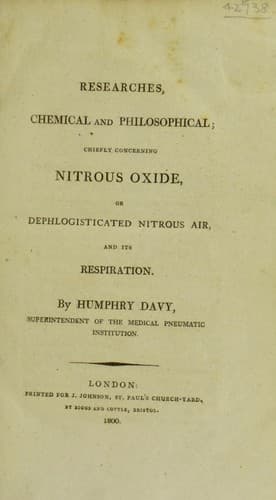
Researches Chemical and Philosophical; Chiefly concerning nitrous oxide: or dephlogisticated nitrous air and its respirationDavy, Humphry, Sir
Science
Researches Chemical and Philosophical; Chiefly concerning nitrous oxide: or dephlogisticated nitrous air and its respiration
Davy, Humphry, Sir
Nitrous oxide
[134] Journal de Physique, tom. xliii. 323.
The diminution of volume sustained by nitrous gas during its conversion
into nitrous oxide, has never been accurately ascertained; it has
generally been supposed to be from two thirds to eight tenths.
_b._ Nitrous gas may be converted into nitrous oxide in two modes.
First, by the simple abstraction of a portion of its oxygene, by bodies
possessing a strong affinity for that principle, such as alkaline
sulphites, muriate of tin, and dry sulphures.
Second, by the combination of a body with a portion both of its oxygene
and nitrogene, such as hydrogene, when either in a nascent form, or a
peculiar state of combination.
_c._ Each of these modes will be distinctly treated of; and to prevent
unnecessary repetitions, I shall give an account of the general manner
in which the following experiments on the conversion of nitrous gas
into nitrous oxide, have been conduced.
Nitrous gas, the purity of which has been accurately ascertained by
solution of muriate of iron, is introduced into a graduated jar filled
with dry mercury. If a fluid substance is designed for the conversion
of the gas into nitrous oxide, it is heated, to expel any loosely
combined air which might be liberated during the process; and then
carefully introduced into the jar, by means of a small phial. After
the process is finished, and the diminution accurately noted, the
nitrous oxide formed is absorbed by pure water. If any nitrous gas
remains, it is condensed by solution of muriate of iron; other residual
gases are examined by the common tests. The quantity of nitrous oxide
dissolved by the fluid is determined by a comparative experiment; and
the corrections for temperature and pressure being guessed at, the
conclusions drawn.
If a solid substance is used, rather more nitrous gas than that
designed for the conversion, is introduced into the jar. The substance
is brought in contact with the gas, by being carried under the mercury;
and as a little common air generally adheres to it, a small portion
of the nitrous gas is transferred into a graduated tube, after the
insertion, and its purity ascertained. In other respects the process is
conducted as mentioned above.
II. _Of the conversion of Nitrous gas into Nitrous Oxide, by Alkaline
Sulphites._
The alkaline sulphites, particularly the sulphite of potash, convert
nitrous gas into nitrous oxide, with much greater rapidity than any
other bodies.
At temperature 46°, 16 cubic inches of nitrous gas were converted, in
less than an hour, into 7,8 of nitrous oxide, by about 100 grains of
pulverised sulphite of potash, containing its water of crystalisation.
No sensible increase of temperature was produced during the process,
no water was decomposed, and the quantity of nitrogene remaining after
the experiment, was exactly equal to that previously contained in the
nitrous gas.
Public-domain text, read in full here on John Shaqi.
Reviews
Reviews
No reviews yet
Be the first to share your thoughts on this work.
Elsewhere in the archive
Join the Discussion
Join the discussion
Sign in to leave a comment or review.
Sign InorCreate an account