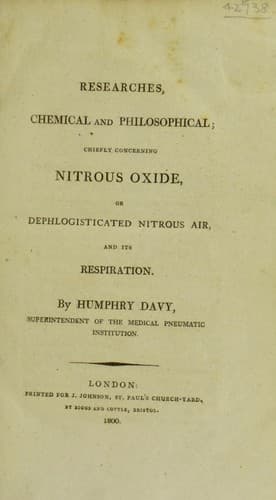
Researches Chemical and Philosophical; Chiefly concerning nitrous oxide: or dephlogisticated nitrous air and its respirationDavy, Humphry, Sir
Science
Researches Chemical and Philosophical; Chiefly concerning nitrous oxide: or dephlogisticated nitrous air and its respiration
Davy, Humphry, Sir
Nitrous oxide
The nitrous oxide produced from nitrous gas by sulphite of potash, has
all the properties of that generated from the decomposition of nitrate
of ammoniac. It gives, as will be seen hereafter, the same products by
analysis. Phosphorus, the taper, sulphur, and charcoal, burn in it with
vivid light. It is absorbable by water, and capable of expulsion from
it unaltered, by heat.
Nitrous gas is converted into nitrous oxide by the alkaline sulphites
with the same readiness, whether exposed to the light, or deprived of
its influence.
The solid sulphites act upon nitrous gas much more readily than
their concentrated solutions; they should however always be suffered
to retain their water of crystalisation, or otherwise they attract
moisture from the gas, and render it drier, and in consequence more
condensed than it would otherwise be. In case perfectly dry sulphites
are employed, the gas should be always saturated with moisture after
the experiment, by introducing into the cylinder a drop of water.
The sulphites, after exposure to nitrous gas, are either found wholly,
or partially, converted into sulphates. Consequently the conversion of
nitrous gas into nitrous oxide by these bodies, simply depends on the
abstraction of a portion of its oxygene; the nitrogene and remaining
oxygene assuming a more condensed state of existence.
If we reason from the different specific gravities of nitrous oxide and
nitrous gas, as compared with the diminution of volume of nitrous gas,
during its conversion into nitrous oxide, 100 parts of nitrous gas,
supposing the former estimation of the composition of nitrous oxide
given in Division III, accurate, would consist of 54 oxygene, and 46
nitrogene; which is not far from the true estimation. Or assuming the
composition of nitrous gas, as given in Division IV, it would appear
from the diminution, that 100 parts of nitrous oxide consisted of 38
oxygene, and 62 nitrogene.
III. _Conversion of Nitrous Gas into Nitrous Oxide, by Muriate of Tin,
and dry Sulphures._
_a._ Nitrous gas exposed to dry muriate of tin, is slowly converted
into nitrous oxide: during this process the apparent diminution is
to about one half; but if the products are nicely examined, and the
necessary corrections made, the real diminution of nitrous gas by
muriate of tin, will be the same as by the sulphites; that is, 100
parts of it will be converted into 48 of nitrous oxide.
During this conversion, no water is decomposed, and no nitrogene
evolved. Solution of muriate of tin converts nitrous gas into nitrous
oxide; but with much less rapidity than the solid salt.
_b._ Nitrous gas exposed to dry and perfectly well made sulphures,
particularly such as are produced from crystalised alumn[135] and
charcoal not sufficiently inflammable to burn in the atmosphere, is
converted into nitrous oxide by the simple abstraction of a portion of
its oxygene, and consequently undergoes a diminution of ⁵²/₁₀₀.
Public-domain text, read in full here on John Shaqi.
Reviews
Reviews
No reviews yet
Be the first to share your thoughts on this work.
Elsewhere in the archive
Join the Discussion
Join the discussion
Sign in to leave a comment or review.
Sign InorCreate an account