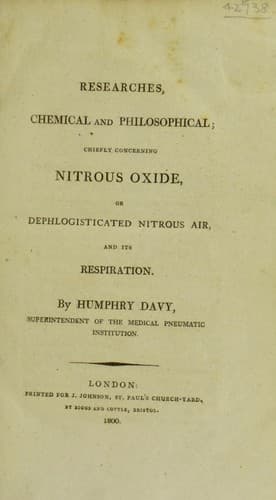
Researches Chemical and Philosophical; Chiefly concerning nitrous oxide: or dephlogisticated nitrous air and its respirationDavy, Humphry, Sir
Science
Researches Chemical and Philosophical; Chiefly concerning nitrous oxide: or dephlogisticated nitrous air and its respiration
Davy, Humphry, Sir
Nitrous oxide
It is probable, that all the bodies having strong affinity for oxygene
will, at certain temperatures, convert nitrous gas into nitrous oxide.
Priestley, and the Dutch chemists, effected the change by heated
sulphur. Perhaps nitrous gas sent through a tube heated, but not
ignited, with phosphorus, would be converted into nitrous oxide.
[135] That is, alumn containing sulphate of potash.
IV. _Decomposition of Nitrous Gas, by Sulphurated Hydrogene._
_a._ When nitrous gas and sulphurated hydrogene are mingled together,
a decomposition of them slowly takes place. The gases are diminished,
sulphur deposited, nitrous oxide formed, and signs of the production of
ammoniac[136] and water perceived.
[136] The production of ammoniac in this process was observed by Kirwan
and Austin.
In this process no sulphuric, or sulphureous acid is produced;
consequently none of the sulphur is oxydated, and of course the changes
depend upon the combination of the hydrogene of the sulphurated
hydrogene, with different portions of the oxygene and nitrogene of the
nitrous gas, to form water and ammoniac, the remaining oxygene and
nitrogene assuming the form of nitrous oxide.
This singular exertion of attractions by a simple body, appears
highly improbable a priori, nor did I admit it, till the formation of
ammoniac, and the non-oxygenation of the sulphur, were made evident by
many experiments.
In those experiments, the diminution of the nitrous gas was not
uniformly the same. It varied from ¹¹/₂₀ to ¹⁴/₂₀. In the most accurate
of them, 5 cubic inches of nitrous gas were converted into 2.2 of
nitrous oxide. Consequently the quantity of ammoniac formed was,047
grains.
In experiments on the conversion of nitrous gas into nitrous oxide, by
sulphurated hydrogene, the gases should be rendered as dry as possible.
The presence of water considerably retards the decomposition.
_b._ The sulphures[137] dissolved in water convert nitrous gas into
nitrous oxide. This decomposition is not, however, produced by the
simple abstraction of oxygene from the nitrous gas to form sulphuric
acid. It depends as well on the decomposition of the sulphurated
hydrogene dissolved in the solution, or liberated from it. In this
process sulphur is deposited on the surface of the fluid, sulphuric
acid is formed, and the diminution, making the necessary corrections,
is nearly the same as when free sulphurated hydrogene is employed.
[137] Solution of sulphure of strontian, or barytes, should be used.
During the conversion of nitrous gas into nitrous oxide by those
bodies, a thin film is deposited on the surface of the solution.
This film examined, is found to consist of sulphur and sulphate.
Possibly the nitrous gas is wholly decomposed by the hydrogene of the
sulphurated hydrogene in the solution, whilst the sulphate is produced
from water decompounded by the sulphur to form more gas for the
saturation of the hydro-sulphure.
Public-domain text, read in full here on John Shaqi.
Reviews
Reviews
No reviews yet
Be the first to share your thoughts on this work.
Elsewhere in the archive
Join the Discussion
Join the discussion
Sign in to leave a comment or review.
Sign InorCreate an account