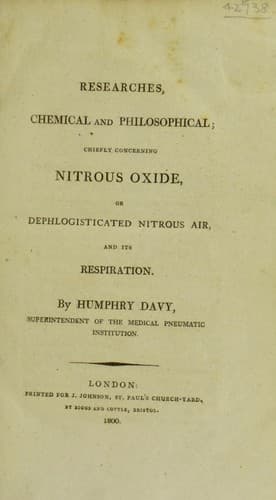
Researches Chemical and Philosophical; Chiefly concerning nitrous oxide: or dephlogisticated nitrous air and its respirationDavy, Humphry, Sir
Science
Researches Chemical and Philosophical; Chiefly concerning nitrous oxide: or dephlogisticated nitrous air and its respiration
Davy, Humphry, Sir
Nitrous oxide
It is extremely probable that sulphurated hydrogene, in combination
with the alkalies, as well as with water, is capable of being slowly
decomposed by nitrous gas.
V. _Decomposition of Nitrous Gas by Nascent Hydrogene._
_a._ When nitrous gas, is exposed to wetted iron filings, a diminution
of its volume slowly takes place; and after a certain time, it is found
converted into nitrous oxide.
In this process ammoniac[138] is formed, and the iron partially
oxydated.
[138] As was first observed by Priestley and Austin, and as I have
proved by many experiments.
The water in contact with the iron is decomposed by the combination of
its oxygene with that substance, and of its hydrogene with a portion
of the oxygene and nitrogene of the nitrous gas, to form water and
ammoniac.
That the iron is not oxydated at the expence of the oxygene of the
nitrous gas, appears very probable from the analogy between this
process, and the mutual decomposition of nitrous gas and sulphurated
hydrogene. Besides, dry iron filings effect no change whatever in
nitrous gas, at common temperatures.
I have generally found about 12 of nitrous gas converted into 5 of
nitrous oxide in this process; which is not very different from the
diminution by sulphurated hydrogene. It takes place equally well in
light and darkness; but more rapidly in warm weather than in cold.
_b._ Nitrous gas exposed to a large surface of zinc, in contact with
water, is slowly converted into nitrous oxide; at the same time that
ammoniac is generated, and white oxide of zinc formed. This process
appears to depend, like the last, upon the decomposition of water by
the affinities of part of the oxygene and nitrogene of nitrous gas,
for its hydrogene, to form ammoniac and water; and by that of zinc
for its oxygene. Zinc placed in contact with water, and confined by
mercury,[139] decomposes it at the common temperature. Zinc, when
perfectly dry, does not in the slightest degree act upon nitrous gas.
[139] As I have found by experiment.
I have not been able to determine exactly the diminution of volume of
nitrous gas, during its conversion into nitrous oxide by zinc. In one
experiment 20 measures of nitrous gas, containing about,03 nitrogene,
were diminished to 9, after an exposure of eight days to wetted zinc;
but from an accident, I was not able to ascertain the exact quantity of
nitrous oxide formed.
_c._ It is probable that most of the imperfect metals will be found
capable of oxydation, by the decomposition of water, when its
hydrogene is attracted by the oxygene and nitrogene of nitrous gas.
I have this day (April 14, 1800), examined two portions of nitrous
gas, one of which had been exposed to copper filings, and the other to
powder of tin, for twenty-three days.
The gas that had been exposed to copper was diminished nearly two
fifths. The taper burnt in it with an enlarged flame, blue at the
edges. Hence it evidently contained nitrous oxide.
Public-domain text, read in full here on John Shaqi.
Reviews
Reviews
No reviews yet
Be the first to share your thoughts on this work.
Elsewhere in the archive
Join the Discussion
Join the discussion
Sign in to leave a comment or review.
Sign InorCreate an account