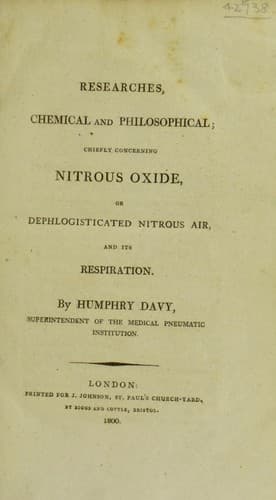
Researches Chemical and Philosophical; Chiefly concerning nitrous oxide: or dephlogisticated nitrous air and its respirationDavy, Humphry, Sir
Science
Researches Chemical and Philosophical; Chiefly concerning nitrous oxide: or dephlogisticated nitrous air and its respiration
Davy, Humphry, Sir
Nitrous oxide
The nitrous gas in contact with tin had undergone a diminution of one
fourth only, and did not support flame.
VI. _Miscellaneous Observations on the conversion of Nitrous Gas into
Nitrous Oxide._
_a._ Dr. Priestley found nitrous gas exposed to a mixture of iron
filings and sulphur, with water, converted after a certain time, into
nitrous oxide. Sulphurated hydrogene is always produced during the
combination of iron and sulphur, when they are in contact with water;
and by the hydrogene of this in the nascent state, the nitrous gas is
most probably decomposed.
_b._ Green oxide of iron moistened with water, exposed to nitrous gas,
slowly gains an orange tinge, whilst the gas is diminished. Most likely
it is converted into nitrous oxide; but this I have not ascertained.
_c._ I exposed nitrous gas, to the following bodies over mercury
for many days, without any diminution, or apparent change in its
properties. Alcohol, saccharine matter, hydrocarbonate, sulphureous
acid, and phosphorus.
_d._ Crystalised sulphate, and muriate of iron, absorb a small quantity
of nitrous gas, and become dark colored on the outside; but after this
absorption, (which probably depends on their water of crystalisation,)
has taken place, no change is effected in the gas remaining.
_e._ The power of iron to decompose water being much increased by
increase of temperature, nitrous gas is converted into nitrous oxide
much more rapidly when placed in contact with a surface of heated
iron, than when exposed to it at common temperatures. During the
decomposition of nitrous gas in this way, ammoniac[140] is formed.
_f._ The curious experiments of Rouppe,[141] on the absorption of gases
by charcoal, compared with the phænomena noticed in this Division,
render it probable that hydrogene in a state of loose combination with
charcoal, will be found to convert nitrous gas into nitrous oxide.
[140] As was observed by Milner. Nitrous gas passed over heated zinc,
or tin, I doubt not will be found converted into nitrous oxide.
[141] Annales de Chimie, xxxii. p. 3.
VII. _Recapitulation of conclusions concerning the conversion of
Nitrous Gas into Nitrous Oxide._
_a._ Certain bodies having a strong affinity for oxygene, as the
sulphites, dry sulphures, muriate of tin, &c. convert nitrous gas into
nitrous oxide, by simply attracting a portion of its oxygene; whilst
the remaining oxygene enters into combination with the nitrogene, and
they assume a more condensed state of existence.
_b._ Nitrous gas is converted into nitrous oxide by hydrogene, in a
peculiar state of existence, as in sulphurated hydrogene; and that by
a series of very complex affinities. Both oxygene and nitrogene are
attracted from the nitrous gas by the hydrogene, in such proportions
as to form water and ammoniac, whilst the remaining oxygene and
nitrogene[142] assume the form of nitrous oxide.
Public-domain text, read in full here on John Shaqi.
Reviews
Reviews
No reviews yet
Be the first to share your thoughts on this work.
Elsewhere in the archive
Join the Discussion
Join the discussion
Sign in to leave a comment or review.
Sign InorCreate an account