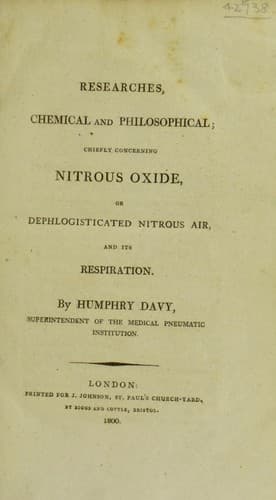
Researches Chemical and Philosophical; Chiefly concerning nitrous oxide: or dephlogisticated nitrous air and its respirationDavy, Humphry, Sir
Science
Researches Chemical and Philosophical; Chiefly concerning nitrous oxide: or dephlogisticated nitrous air and its respiration
Davy, Humphry, Sir
Nitrous oxide
[142] The decomposition and recomposition of water, in this process,
are analogous to some of the phænomena observed by the ingenious Mrs.
Fulhame.
_c._ Nitrous gas placed in contact with bodies, such as iron and
zinc decomposing water, is converted into nitrous oxide, at the same
time that ammoniac is formed. It is difficult to ascertain the exact
rationale of this process. For either the nascent hydrogene produced by
the decomposition of the water by the metallic substance may combine
with portions of both the oxygene and nitrogene of the nitrous gas; and
thus by forming water and ammoniac, convert it into nitrous oxide. Or
the metallic substance may attract at the same time oxygene from the
water and nitrous gas, whilst the nascent hydrogene of the water seizes
upon a portion of the nitrogene of the nitrous gas to form ammoniac.
The degree of diminution, and the analogy between this process and the
decomposition of nitrous gas by sulphurated hydrogene, render the first
opinion most probable.
VIII. _The production of Nitrous Oxide during the oxydation of Tin,
Zinc, and Iron, in Nitric Acid._
_a._ Dr. Priestley discovered, that during the solution of tin, zinc,
and iron, in nitric acid, certain portions of nitrous oxide were
produced, mingled with quantities of nitrous gas, and nitrogene,
varying in proportion as the acid employed was more or less
concentrated.
It has long been known that ammoniac is formed during the solution of
tin, zinc, and iron, in diluted nitric acid. Consequently, in these
processes water is decomposed.
I had designed to investigate minutely these phænomena, so as to
ascertain the quantities of water and acid decompounded, and of the new
products generated. But after going through some experiments on the
oxydation of tin without gaining conclusive results, the labor, and
sacrifice of time they demanded, obliged me to desist from pursuing the
subject, till I had completed more important investigations.
I shall detail the few observations which have occurred to me, relating
to the production of nitrous oxide from metallic solutions.
_b._ When tin is dissolved in concentrated nitric acid, such as of
1.4, nitrous oxide is produced, mingled with generally more than twice
its bulk of nitrous gas. In this process but little free nitrogene is
evolved, and the tin is chiefly precipitated in the form of a white
powder. If the solution, after the generation of these products, is
saturated with lime, and heated, the ammoniacal smell is distinct.
When nitric acid of specific gravity 1.24, is made to act upon tin;
in the beginning of the process, nearly equal parts of nitrous gas
and nitrous oxide are produced; as it advances, the proportion of
nitrous oxide to the nitrous gas increases: the largest quantity of
nitrous oxide that I have found in the gas procured from tin is ¾, the
remainder being nitrous gas and nitrogene.
Public-domain text, read in full here on John Shaqi.
Reviews
Reviews
No reviews yet
Be the first to share your thoughts on this work.
Elsewhere in the archive
Join the Discussion
Join the discussion
Sign in to leave a comment or review.
Sign InorCreate an account