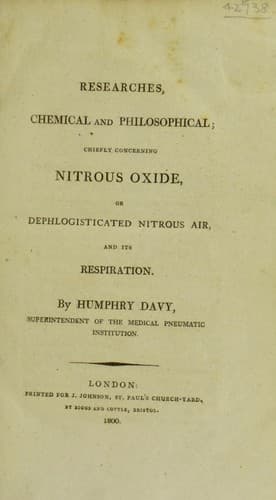
Researches Chemical and Philosophical; Chiefly concerning nitrous oxide: or dephlogisticated nitrous air and its respirationDavy, Humphry, Sir
Science
Researches Chemical and Philosophical; Chiefly concerning nitrous oxide: or dephlogisticated nitrous air and its respiration
Davy, Humphry, Sir
Nitrous oxide
When tin is oxydated in an acid of less specific gravity than 1.09, the
quantities of gas disengaged are very small, and consist of nitrogene,
mingled with minute portions of nitrous oxide, and nitrous gas.
Whenever I have saturated solutions of tin in nitric acid of different
specific gravities, with lime, and afterwards heated them, the
ammoniacal smell has been uniformly perceptible, and generally most
distinct when diluted acids have been employed.
_c._ When zinc is dissolved in nitric acid, whatever is its specific
gravity, certain quantities of nitrous oxide are produced.
Nitric acids of greater specific gravity than 1.2, act upon zinc with
great rapidity, and great increase of temperature. The gases disengaged
from these solutions consist of nitrous gas, nitrous oxide, and
nitrogene; the nitrous oxide rarely equals one third of the whole.
When nitric acid of 1,104 is made to dissolve zinc, the gas obtained in
the middle of the process consists chiefly of nitrous oxide. From such
a solution I obtained gas which gave a residuum of one sixth only when
absorbed by water. The taper burnt in it with a brilliant flame, and
sulphur with a vivid rose-colored light.
100 grains of granulated zinc, during their solution in 300 grains
of nitric acid, of 1,43, diluted with 14 times its weight of water,
produced 26 cubic inches of gas. Of this gas ⁷/₃₆ were nitrous, ¹⁷/₃₆36
nitrous oxide, and the remainder nitrogene. The solution saturated with
lime and heated, gave a distinct smell of ammoniac.
_d._ During the solution of iron in concentrated nitric acid, the gas
given out is chiefly nitrous; it is however generally mingled with
minute quantities of nitrous oxide. When very dilute nitric acids
are made to act upon iron, by the assistance of heat, nitrous oxide
is produced in considerable quantities, mingled with nitrous gas
and nitrogene; the proportions of which are smaller as the process
advances.[143] The fluid remaining after the oxydation and solution of
iron in nitric acid, always contains ammoniac.
[143] From one of Dr. Priestley’s experiments, it appears that
hydrogene gas is sometimes disengaged during the solution of iron in
very dilute nitric acid by heat. This phænomenon has never occurred to
me.
_e._ As during the solution of tin, zinc, and iron, in nitric acid, the
quantity of acid is diminished in proportion as the process advances,
it is reasonable to suppose that the relative quantities of the gases
evolved are perpetually varying. In the beginning of a dissolution,
the nitrous gas generally predominates, in the middle nitrous oxide,
and at the end nitrogene.
Public-domain text, read in full here on John Shaqi.
Reviews
Reviews
No reviews yet
Be the first to share your thoughts on this work.
Elsewhere in the archive
Join the Discussion
Join the discussion
Sign in to leave a comment or review.
Sign InorCreate an account