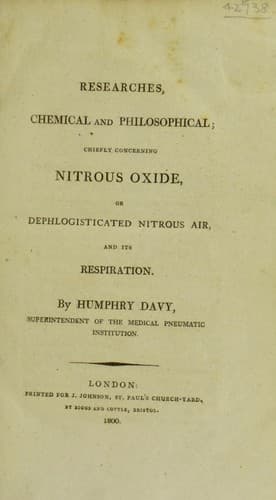
Researches Chemical and Philosophical; Chiefly concerning nitrous oxide: or dephlogisticated nitrous air and its respirationDavy, Humphry, Sir
Science
Researches Chemical and Philosophical; Chiefly concerning nitrous oxide: or dephlogisticated nitrous air and its respiration
Davy, Humphry, Sir
Nitrous oxide
_f._ During the generation of nitrous gas, nitrous oxide, and ammoniac,
from the decomposition of solution of nitric acid in water, by tin,
zinc, and iron, very complex attractions must exist between the
constituents of the substances employed. The acid and the water are
decomposed at the same time, and in proportions different as the
solution is more concentrated, by the combination of their oxygene with
the metallic body.
The nitrous gas is produced by the combination of the metal with
³²/₁₀₀ of the oxygene of the acid. The nitrous oxide is most probably
generated by the decomposition of a portion of the nitrous gas
disengaged, by the nascent hydrogene of the water decompounded; some
of it may be possibly formed from a more complete decomposition of the
acid.
The production of ammoniac may arise, probably from two causes; from
the decomposition of the nitrous gas by the combination of the nascent
hydrogene of the water, with portions of its oxygene and nitrogene at
the same time; and from the union of hydrogene with nascent nitrogene
liberated in consequence of a complete decomposition of part of the
acid.
IX. _Additional Observations on the production of Nitrous Oxide._
_a._ When nitric acid is combined with muriatic acid, or sulphuric
acid,[144] the quantities of nitrous oxide produced from its
decomposition by tin, zinc, and iron, are rather increased than
diminished. The nitrous oxide obtained from these solutions is,
however, never sufficiently pure for physiological experiments. It is
always mingled with either nitrous gas, nitrogene, or hydrogene, and
sometimes with all of them.
[144] As was discovered by Priestley, and the Dutch Chemists.
_b._ From the solutions of bismuth, nickel, lead, and copper, in
diluted nitric acid, I have never obtained any perceptible quantity
of nitrous oxide: the gas produced is nitrous, mingled with different
portions of nitrogene. Antimony and mercury, during their solution in
aqua regia, give out only nitrous gas.
Probably none of the metallic bodies, except those that decompose
water at temperatures below ignition, will generate nitrous oxide from
nitric acid. On cobalt and manganese I have never had an opportunity of
experimenting: manganese will probably produce nitrous oxide.
_c._ During the solution of vegetable matters[145] in nitric acid, by
heat, very minute portions of nitrous oxide are sometimes produced,
always however mingled with large quantities of nitrous gas, and
carbonic acid.
[145] Such as the leaves, bark, and wood, of trees.
When nitric acid is decompounded by ether, fixed oils, volatile oils,
or alcohol, towards the end of the process small quantities of nitrous
oxide are produced, and sometimes sufficiently pure to support the
flame of the taper.[146]
_d._ When green oxide of iron is dissolved in nitric acid, nitrous
oxide is produced, mingled with nitrogene and nitrous gas.
Public-domain text, read in full here on John Shaqi.
Reviews
Reviews
No reviews yet
Be the first to share your thoughts on this work.
Elsewhere in the archive
Join the Discussion
Join the discussion
Sign in to leave a comment or review.
Sign InorCreate an account