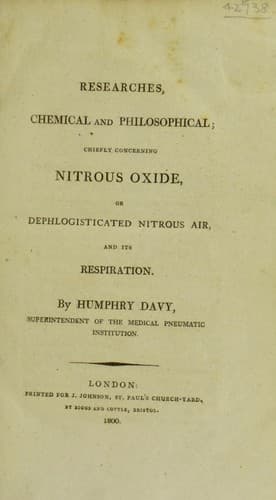
Researches Chemical and Philosophical; Chiefly concerning nitrous oxide: or dephlogisticated nitrous air and its respirationDavy, Humphry, Sir
Science
Researches Chemical and Philosophical; Chiefly concerning nitrous oxide: or dephlogisticated nitrous air and its respiration
Davy, Humphry, Sir
Nitrous oxide
_e._ During the conversion of green sulphate, or green muriate of iron
into red, by the decomposition of dilute nitric acid, nitrous oxide is
formed, mingled with different proportions of nitrous gas and nitrogene.
_f._ When solution of green nitrate of iron is heated, a part of the
acid is decomposed, red oxide is precipitated, red nitrate formed, and
impure nitrous oxide evolved.
_g._ When iron is introduced into a solution of nitrate of copper, the
copper is precipitated in its metallic state, whilst nitrous oxide,
mingled with small portions of nitrogene, is produced.[147]
[146] As I have observed after Priestley.
[147] As was discovered by Priestly.
Both zinc and tin precipitate copper in its metallic form from
solution in the nitric acid. During these precipitations, certain
quantities of nitrous oxide are generated, mingled however with larger
quantities of nitrogene than that produced from decomposition by iron.
In all these processes ammoniac is formed, and water consequently
decomposed.
The decomposition of water and nitric acid, during the precipitation
of copper from solution of nitrate of copper, by tin, zinc, and iron,
depends upon the strong affinity of those metals for oxygene, and their
powers of combining with a larger quantity of it than copper.
X. _Decomposition of Aqua Regia by Platina, and evolution of a Gas
analogous to Oxygenated Muriatic Acid, and Nitrogene._
_a._ De la Metherie, in his essay on different airs, has asserted that
the gas produced by the solution of platina in nitro-muriatic acid, is
identical with the dephlogisticated nitrous gas of Priestly. He calls
it nitrous gas with excess of pure air, and affirms that it diminishes,
both with nitrous gas and common air.
_b._ I introduced into a vessel containing 30 grains of platina,
2050 grains of aqua regia, composed of equal parts, by weight, of
concentrated nitric acid of 1,43, and muriatic acid of 1,16. At the
common temperature, that is, 49°, no action between the acid and
platina appeared to take place. On the application of the heat of a
spirit lamp, the solution gradually became yellow red, and gas was
given out with rapidity. Some of this gas received in a jar filled
with warm water, appeared of a bright yellow color. On agitation,
the greater part of it was absorbed by the water, and the remainder
extinguished flame. When it was received over mercury, it acted upon it
with great rapidity, and formed on the surface a white crust.
As the process of solution advanced, the color of the acid changed
to dark red, at the same time that the production of gas was much
increased; more than 40 cubic inches were soon collected in the water
apparatus.
Different portions of the gas were examined, it exhibited the following
properties:
1. Its color was orange red,[148] and its smell exactly
resembled that of oxygenated muriatic acid.
Public-domain text, read in full here on John Shaqi.
Reviews
Reviews
No reviews yet
Be the first to share your thoughts on this work.
Elsewhere in the archive
Join the Discussion
Join the discussion
Sign in to leave a comment or review.
Sign InorCreate an account