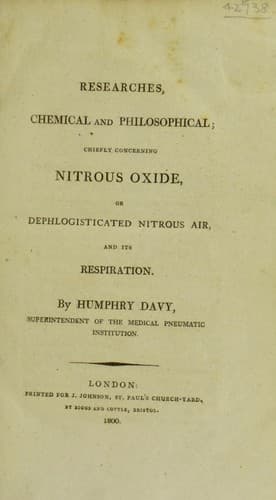
Researches Chemical and Philosophical; Chiefly concerning nitrous oxide: or dephlogisticated nitrous air and its respirationDavy, Humphry, Sir
Science
Researches Chemical and Philosophical; Chiefly concerning nitrous oxide: or dephlogisticated nitrous air and its respiration
Davy, Humphry, Sir
Nitrous oxide
2. When agitated in boiled water, it was rapidly absorbed,
leaving a residuum of rather more than one twelfth.
3. The taper burnt in it with increased brilliancy,
the flame being long, and deep red at the edges.
4. Iron introduced into it ignited, burnt with a dull
red light.
5. Green vegetables exposed to it were instantly
rendered white.
6. It underwent no diminution, mingled with
atmospheric air.
7. When mingled with nitrous gas, it gave dense red
vapor, and rapid diminution.
[148] This deep color depended, in some measure, upon the
nitro-muriatic vapor suspended in it. I have since observed that it is
more intense in proportion as the heat employed for the production of
the gas has been stronger. The natural color of the peculiar gas is
deep yellow.
_c._ From the exhibition of these properties, it was evident that the
gas produced during the solution of platina in aqua regia, chiefly
consisted of oxygenated muriatic acid, or of a gas highly analogous to
it. It was, however, difficult to conceive how a body, by combining
with a portion of the oxygene of nitro-muriatic acid, could produce
from it oxygenated muriatic acid, apparently mingled with very small
portions of any other gas.
_d._ To ascertain whether any permanent gas was produced during the
ebullition of aqua regia, of the same composition as that used for the
solution of the platina; I kept a large quantity of it boiling for some
time, in communication with the water apparatus; the gas generated
appeared to be wholly nitro-muriatic, and was absorbed as fast as
produced, by the water.
_e._ To determine whether any nitrous oxide was mingled with the
peculiar gas, as well as the nature and quantity of the unabsorbable
gas, nitrous gas was gradually added to 21 cubic inches of the gas
produced from a new solution, till the diminution was complete: the gas
remaining equalled 2,3 cubic inches; it was unabsorbable by water, and
extinguished flame.
In another experiment, when the last portions of gas from a solution
were carefully received in water previously boiled, 12 cubic inches
agitated in water left a residuum of 1.3; whilst the same quantity
decomposed by nitrous gas, containing,02 nitrogene, left about 1.5.
Hence it appeared that the aëriform products of the solution consisted
of the peculiar gas analogous to oxygenated muriatic acid, and of a
small quantity of nitrogene.
_f._ Consequently a portion of the nitric acid of the aqua regia had
been decomposed; but if it had given oxygene both to the platina and
muriatic acid, the quantity of nitrogene evolved ought to have been
much more considerable.
_g._ To ascertain if any water had been decomposed, and the nitrogene
condensed in the solution by its hydrogene, to form ammoniac, I
saturated a solution with lime, and heated it, but no ammoniacal smell
was perceived.
Public-domain text, read in full here on John Shaqi.
Reviews
Reviews
No reviews yet
Be the first to share your thoughts on this work.
Elsewhere in the archive
Join the Discussion
Join the discussion
Sign in to leave a comment or review.
Sign InorCreate an account