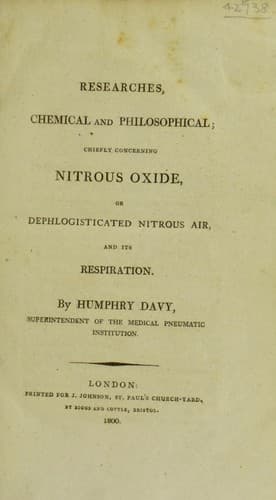
Researches Chemical and Philosophical; Chiefly concerning nitrous oxide: or dephlogisticated nitrous air and its respirationDavy, Humphry, Sir
Science
Researches Chemical and Philosophical; Chiefly concerning nitrous oxide: or dephlogisticated nitrous air and its respiration
Davy, Humphry, Sir
Nitrous oxide
In comparing the experiments of the illustrious Cavendish on the
synthesis of nitrous acid, with those of Lavoisier on the decomposition
of nitre by charcoal, we find a much greater difference in the results
than can be accounted for by supposing the acid formed, and that
decomposed, of different degrees of oxygenation.
In the most accurate experiment of Cavendish, when the nitrous acid
appeared to be in a state of deoxygenation, 1 of nitrogene combined
with about 2,346 of oxygene.[3] In an earlier experiment, when the
acid was probably fully oxygenated, the nitrogene employed was to the
oxygene nearly as 1 to 2,92.[4]
Lavoisier, from his experiments on the decomposition of nitre, and
combination of nitrous gas and oxygene, concludes, that the perfectly
oxygenated, or what he calls nitric acid, is composed of nearly 1
nitrogene, with 3,9 of oxygene; and the acid in the last state of
deoxygenation, or nitrous acid, of about 3 oxygene with 1 nitrogene.[5]
[3] Phil. Trans. v. 78, p. 270.
[4] Phil. Trans. v. 75 p. 381.
[5] Elem. Kerr’s Trans. page 76, and 216, and Mem. des Sav. Etrang.
tom. 7, page 629.
Great as the difference is between the estimations of these
philosophers, we find differences still greater in the accounts of the
quantities of nitrous gas necessary to saturate a given quantity of
oxygene, as laid down by very accurate experimentalists. On the one
hand, Priestley found 1 of oxygene condensed by 2 of nitrous gas, and
Lavoisier by 1⅞. On the other, Ingenhouz, Scherer, and De la Metherie,
state the quantity necessary to be from 3 to 5.[6] Humbolt, who has
lately investigated Eudiometry with great ingenuity, considers the mean
quantity of nitrous gas necessary to saturate 1 of oxygene, as about
2,55.[7]
[6] Ingenhouz sur les Vegetaux, pag. 205. De la Metherie. Essai sur
differens Airs, pag. 252.
[7] Annales de Chimie, tome 28, p. 168.
II. To reconcile these different results is impossible, and the
immediate connection of the subject with the production of nitrous
oxide, as well as its general importance, obliged me to search for
means of accurately determining the composition of nitrous acid in its
different degrees of oxygenation.
The first desideratum was to ascertain the nature and composition of a
fluid acid, which by being deprived of, or combined with nitrous gas,
might become a standard of comparison for all other acids.
To obtain this acid I should have preferred the immediate combination
of oxygene and nitrogene over water by the electric spark, had it
been possible to obtain in this way by a common apparatus sufficient
for extensive examination; but on carefully perusing the laborious
experiments of Cavendish, I gave up all thoughts of attempting it.
Public-domain text, read in full here on John Shaqi.
Reviews
Reviews
No reviews yet
Be the first to share your thoughts on this work.
Join the Discussion
Join the discussion
Sign in to leave a comment or review.
Sign InorCreate an account