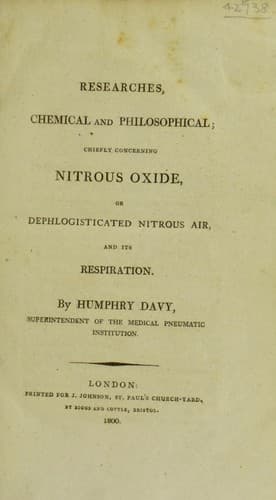
Researches Chemical and Philosophical; Chiefly concerning nitrous oxide: or dephlogisticated nitrous air and its respiration — John Shaqi
Researches Chemical and Philosophical; Chiefly concerning nitrous oxide: or dephlogisticated nitrous air and its respirationDavy, Humphry, Sir
Science
Researches Chemical and Philosophical; Chiefly concerning nitrous oxide: or dephlogisticated nitrous air and its respiration
Davy, Humphry, Sir
Nitrous oxide
My first experiments were made on the decomposition of nitre,
formed from a known quantity of pale nitrous acid of known specific
gravity, by phosphorus, tin, and charcoal: but in those processes,
unascertainable quantities of nitrous acid, with excess of nitrous
gas, always escaped undecompounded, and from the non-coincidence
of results, where different quantities of combustible substances
were employed, I had reasons for believing that water was generally
decomposed.
Before these experiments were attempted, I had analized nitrous gas
and nitrous oxide, in a manner to be particularly described hereafter;
so that a knowledge of the quantities of nitrous gas and oxygene
entering into the composition of any acid, enabled me to determine the
proportions of nitrogene and oxygene it contained. In consequence of
which I attempted to combine together oxygene and nitrous gas, in such
a manner as to absorb the nitrous acid formed by water, in an apparatus
by which the quantities of the gases employed, and the increase of
weight of the water, might be ascertained; but this process likewise
failed. It was impossible to procure the gases perfectly free from
nitrogene, and during their combination, this nitrogene made to pass
into a pneumatic apparatus communicating with a vessel containing the
water carried over with it, much nitrous acid vapor, of different
composition from the acid absorbed.
After many unsuccessful trials, Dr. Priestley’s experiments on nitrous
vapor[8] induced me to suppose that oxygene and nitrous gas, made to
combine out of the contact of bodies having affinity for oxygene, would
remain permanently aëriform, and on throwing them separately into an
exhausted glass balloon, I found that this was actually the case;
increase of temperature was produced, and orange colored nitrous acid
gas formed, which after remaining for many days in the globe, at a
temperature below 56°, did not in the slightest degree condense.
[8] Experiments and Observations, Vol. iii. last edition, page 105, &c.
This fact afforded me the means not only of forming a standard acid,
but likewise of ascertaining the specific gravity of nitrous acid in
its aëriform state.
III. Previous to the experiment, for the purpose of correcting
incidental errors, I was induced to ascertain the specific gravity of
the gases employed, particularly as I was unacquainted with any process
by which the weight of nitrous gas had been accurately determined. Mr.
Kirwan’s estimation, which is generally adopted, being founded upon
the comparison of the loss of weight of a solution of copper in dilute
nitrous acid, with the quantity of gas produced.[9]
The instruments that I made use of for containing and measuring my
gases, were two mercurial airholders graduated to the cubic inch of
Everard, and furnished with stop-cocks.[10]
Public-domain text, read in full here on John Shaqi.
Reviews
Reviews
No reviews yet
Be the first to share your thoughts on this work.
Join the Discussion
Join the discussion
Sign in to leave a comment or review.
Sign InorCreate an account