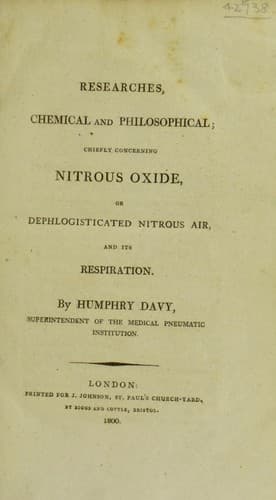
Researches Chemical and Philosophical; Chiefly concerning nitrous oxide: or dephlogisticated nitrous air and its respirationDavy, Humphry, Sir
Science
Researches Chemical and Philosophical; Chiefly concerning nitrous oxide: or dephlogisticated nitrous air and its respiration
Davy, Humphry, Sir
Nitrous oxide
_b._ Nitrous oxide is scarcely at all soluble in nitrous acid, and
exposed to that substance, undergoes no alteration.
_c._ Muriatic acid, of specific gravity 1,14 absorbs about a third
of its bulk of nitrous oxide. It suffers no apparent change in its
properties from being thus impregnated, and the gas is again given out
from it on the application of heat.
_d._ Acetic acid absorbs nearly one third of its bulk of nitrous oxide.
_e._ Aqua regia, that is, the nitro-muriatic acid, absorbs a very
minute portion of nitrous oxide.
_f._ Nitrous oxide was exposed to a new compound acid, consisting of
oxygenated muriatic acid, and sulphuric acid, which I discovered in
July, 1799, and of which an account will be shortly published; but it
was neither absorbed or altered.
I have before mentioned that the aqueous solutions of sulphurated
hydrogene and carbonic acid, neither dissolve or alter nitrous oxide.
IV. _Action of Saline Solutions, and other Substances, on Nitrous
Oxide._
_a._ Nitrous oxide exposed to concentrated solution of green sulphate
of iron, at 58°, underwent no perceptible diminution; not even after it
had been suffered to remain in contact with it for half an hour.
_b._ It underwent diminution of nearly,2 when agitated in contact with
a solution of red sulphate of iron, the volume of the solution being
unity.
_c._ Solution of green sulphate of iron, fully impregnated with nitrous
gas, did not in the slightest degree absorb nitrous oxide, and appeared
to have no action upon it.
_d._ Solution of green muriate of iron, whether impregnated with
nitrous gas, or unimpregnated, has no affinity for, or action upon,
nitrous oxide.
_e._ Solution of red muriate of iron in alcohol, absorbed nearly one
fifth of its bulk, of nitrous oxide.
_f._ Solution of prussiate of potash absorbed nearly one third of its
volume, of nitrous oxide, which was again expelled from it by heat.
_g._ Solution of nitrate of copper appeared to have no affinity for
nitrous oxide.
_h._ Concentrated solution of nitrate of ammoniac, at 58°, absorbed one
eighth of its bulk of nitrous oxide.
_i._ Solutions of alkaline sulphures absorb nitrous oxide in quantities
proportionable to the water they contain; it is expelled from them
unaltered by heat. None of the hydro-sulphures dissolve more than half
their bulk of nitrous oxide.
_k._ Concentrated solutions of the sulphites possess little or
no action on nitrous oxide; diluted solutions absorb it in small
quantities.
_l._ Concentrated solution of muriate of tin absorbs about one eighth
of nitrous oxide; more dilute solutions absorb larger quantities.
Public-domain text, read in full here on John Shaqi.
Reviews
Reviews
No reviews yet
Be the first to share your thoughts on this work.
Elsewhere in the archive
Join the Discussion
Join the discussion
Sign in to leave a comment or review.
Sign InorCreate an account