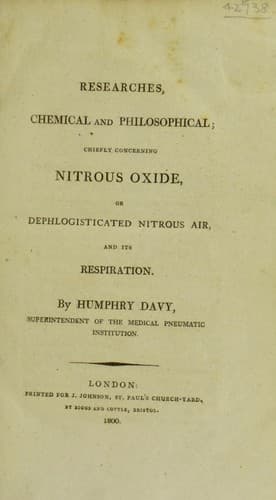
Researches Chemical and Philosophical; Chiefly concerning nitrous oxide: or dephlogisticated nitrous air and its respirationDavy, Humphry, Sir
Science
Researches Chemical and Philosophical; Chiefly concerning nitrous oxide: or dephlogisticated nitrous air and its respiration
Davy, Humphry, Sir
Nitrous oxide
From these observations we learn, that neutro-saline solutions in
general, have very feeble attractions for nitrous oxide; and as
solutions of green muriate, and sulphate of iron, whether free from
nitrous gas, or impregnated with it, possess no action upon nitrous
oxide, nitrous gas may be separated from this substance by those
solutions with greater facility than nitrous oxide can be separated
from nitrous gas, by water or alcohol.
Charcoal absorbs nitrous oxide as well as all other gases; and it is
disengaged from it by heat.
I have as yet found no other solid body, not possessed of alkaline
properties, capable of absorbing nitrous oxide in any state of
existence.
The bodies possessing the strongest affinity for oxygene, the dry
sulphites, muriate of tin, the common sulphures, white prussiate of
potash, and green oxide of iron, do not in the slightest degree act on
nitrous oxide at common temperatures.
V. _Action of different Gases on Nitrous Oxide._
_a._ 12 measures of muriatic acid gas were mingled with 7 measures
of nitrous oxide at 56°. After remaining together for a minute, they
filled a space equal to 19½ measures. When water was introduced to
them, the muriatic acid was absorbed much more slowly than if it had
been unmingled.
In another experiment, when the gases were saturated with water, 9
measures of each of them, when mingled and suffered to remain in
contact for a quarter of an hour, filled a space nearly equal to 19;
and after the muriatic acid had been absorbed by potash, the nitrous
oxide remained unaltered in its properties.
From the expansion, it appears most probable that aëriform muriatic
acid, and nitrous oxide, have a certain affinity for each other, and
that they combine when mingled together; for in the last experiment,
the increase of volume cannot be accounted for by supposing that
nitrous oxide undergoes less change of volume than muriatic acid,
by aëriform combination with water, and that the expansion depended
upon the solution of some of its combined water by the muriatic acid.
That muriatic acid and nitrous oxide have a slight affinity for each
other, likewise appears from the absorption of nitrous oxide by aqueous
solution of muriatic acid.
Thinking that nitrous oxide might attract muriatic acid from its
solution in water, I exposed a minute quantity of fluid muriatic acid
to nitrous oxide; but no alteration of volume took place in the gas.
_b._ 6 measures of nitrous oxide were mingled with 11 measures of
sulphureous acid, saturated with water; after remaining at rest for six
minutes, they filled a space nearly equal to 18 measures. Exposed to
water, the sulphureous acid was absorbed, but not nearly so rapidly as
when in a free state. Sulphur burnt with a vivid flame in the residual
nitrous oxide. 7 measures of sulphureous acid were now mingled with
8 of nitrous oxide. They filled a space nearly equal to 15¾, and no
farther expansion took place afterwards.
Public-domain text, read in full here on John Shaqi.
Reviews
Reviews
No reviews yet
Be the first to share your thoughts on this work.
Elsewhere in the archive
Join the Discussion
Join the discussion
Sign in to leave a comment or review.
Sign InorCreate an account