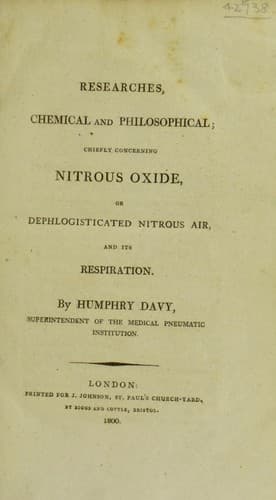
Researches Chemical and Philosophical; Chiefly concerning nitrous oxide: or dephlogisticated nitrous air and its respirationDavy, Humphry, Sir
Science
Researches Chemical and Philosophical; Chiefly concerning nitrous oxide: or dephlogisticated nitrous air and its respiration
Davy, Humphry, Sir
Nitrous oxide
From these experiments it appears probable that sulphureous acid, and
nitrous oxide, have some affinity for each other.
_c._ 11 measures of carbonic acid were mingled with 8 of nitrous
oxide; they filled a space nearly equal to 19 measures. On exposing
the mixture to caustic potash, the carbonic acid was absorbed, and the
nitrous oxide remained pure. Hence it appears that carbonic acid and
nitrous oxide do not combine with each other.
_d._ Oxygenated muriatic acid, and nitrous oxide, were mingled in a
water apparatus: there was a slight appearance of condensation; but
this was most probably owing to absorption by the water; on agitation,
the oxygenated muriatic acid was absorbed, and the greater part of the
nitrous oxide remained unaltered.
_e._ Sulphurated hydrogene and nitrous oxide, mingled together, neither
expanded or contracted; exposed to solution of potash, the acid[154]
only was absorbed.
[154] The experiments of Berthollet have clearly proved the perfect
acidity of this substance.
_f._ 10 measures of nitrous gas were admitted to 12 of nitrous oxide at
59°. They filled a space equal to 22, and after remaining together for
an hour, had undergone no change. Solution of muriate of iron absorbed
the nitrous gas without affecting the nitrous oxide.
_g._ Nitrous oxide was successively mingled with oxygene, atmospheric
air, hydrocarbonate, phosphorated hydrogene, hydrogene, and nitrogene,
at 57°; it appeared to possess no action on any of them, and was
separated by water, the gases remaining unaltered.
_h._ As nitrous oxide was soluble in ether, alcohol, and the other
inflammable fluids, it was reasonable to suppose that its affinity for
those bodies would enable them to unite with it in the aëriform state.
At the suggestion of Dr. Beddoes I made the following experiment:
To 12 measures of nitrous oxide, at 54°, I introduced a single drop of
ether; the gas immediately began to expand, and in four minutes filled
a space equal to sixteen measures and a quarter. When an inflamed taper
was plunged into the gas thus holding ether in solution, a light blue
flame slowly passed through it.
A considerable diminution of temperature is most probably produced,
from the great expansion of nitrous oxide during its combination with
ether.
A drop of alcohol was admitted to 14 measures of nitrous oxide. In five
minutes, the gas filled a space equal to fifteen and a third; but no
farther diminution took place afterwards.
Public-domain text, read in full here on John Shaqi.
Reviews
Reviews
No reviews yet
Be the first to share your thoughts on this work.
Elsewhere in the archive
Join the Discussion
Join the discussion
Sign in to leave a comment or review.
Sign InorCreate an account