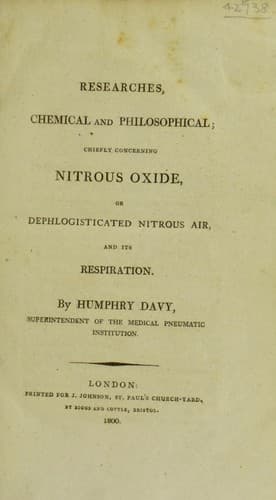
Researches Chemical and Philosophical; Chiefly concerning nitrous oxide: or dephlogisticated nitrous air and its respirationDavy, Humphry, Sir
Science
Researches Chemical and Philosophical; Chiefly concerning nitrous oxide: or dephlogisticated nitrous air and its respiration
Davy, Humphry, Sir
Nitrous oxide
A minute quantity of oil of turpentine was introduced to 14 measures
of nitrous oxide; it filled, in 4 minutes, a space rather less than
14; and no farther change took place afterwards. Most likely this
contraction arose from the precipitation of the water dissolved in the
gas by the stronger affinity of the oil for nitrous oxide. To ascertain
with certainty if any oil had been dissolved by the gas, I introduced
into it a small quantity of ammoniac. It immediately became slightly
clouded, most probably from the formation of soap, by the combination
of the dissolved oil with the ammoniac.
From these experiments we learn, that when nitrous oxide is mingled
with either carbonic acid, oxygene, common air, hydrocarbonate,
sulphurated hydrogene, hydrogene, or nitrogene, they may be separated
from each other without making any allowance for contraction or
expansion; but if a mixture of either muriatic acid, or sulphureous
acid gas, with nitrous oxide, is experimented upon; in the absorption
of the acid by alkalies, the apparent volume of gas condensed will be
less than the real one, by a quantity equal to the sum of expansion
from combination. Consequently a correction must be made on account of
this circumstance.
Though alcohol, ether, essential oils, and the fluid inflammable
bodies in general, dissolve nitrous oxide with much greater rapidity
than water, yet as we are not perfectly acquainted with their action on
unabsorbable gases, it is better to employ water for separating nitrous
oxide from these substances; particularly as that fluid is more or less
combined with all gases, and as we are acquainted with the extent of
its action upon them.
By pursuing the subject of the solution of essential oils in gases,
we may probably discover a mode of obtaining them in a state of
absolute dryness. For if other gases as well as nitrous oxide, have a
stronger affinity for oils than for water, water most probably will
be precipitated from them during their solution of oils; and after
their saturation with oil, it is likely that they are capable of being
deprived of that substance by ammoniac.
VI. _Action of aëriform Nitrous Oxide in the Alkalies. History of the
discovery of the combinations of Nitrous Oxide with the Alkalies._
_a._ When nitrous oxide in a free state is exposed to the solid caustic
alkalies and alkaline earths, at common temperatures, it is neither
absorbed nor acted upon; when it is placed in contact with solutions
of them in water, a small quantity is dissolved; but this combination
appears to depend on the water of the solution, for the gas can be
expelled unaltered, at the temperature of ebullition.
_b._ Caustic potash was exposed to nitrous oxide for 13 hours: the
diminution was not to one fiftieth, and this slight condensation most
probably depended upon its combination with the water of the gas.
Public-domain text, read in full here on John Shaqi.
Reviews
Reviews
No reviews yet
Be the first to share your thoughts on this work.
Elsewhere in the archive
Join the Discussion
Join the discussion
Sign in to leave a comment or review.
Sign InorCreate an account