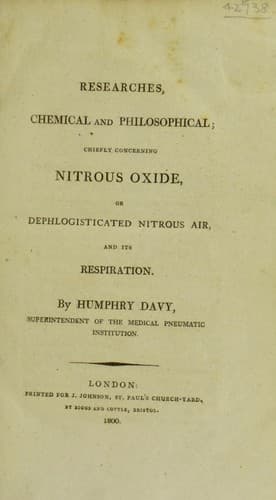
Researches Chemical and Philosophical; Chiefly concerning nitrous oxide: or dephlogisticated nitrous air and its respirationDavy, Humphry, Sir
Science
Researches Chemical and Philosophical; Chiefly concerning nitrous oxide: or dephlogisticated nitrous air and its respiration
Davy, Humphry, Sir
Nitrous oxide
Concentrated solution of potash absorbed a fourth of its bulk of
nitrous oxide. When the impregnated solution was heated, globules of
gas were given out from it rapidly; but the quantity collected was too
small to examine.
Soda, whether solid or in solution, exhibited exactly the same
phænomena with nitrous oxide. The solution of soda absorbed near a
quarter of its bulk of gas.
_c._ 11 measures of ammoniacal gas were mingled with 8 measures of
nitrous oxide over dry mercury, both of the gases being saturated with
water. No change of appearance was produced by the mixture, and they
filled, after two minutes, a space equal to 19. On the introduction
of a little water, the ammoniac was absorbed, and the nitrous oxide
remained unaltered, for it was dissolved by water as rapidly as if it
had never been mingled with ammoniac.[155]
[155] The Dutch chemists have asserted, that mixture with ammoniac
prevents the absorption of nitrous oxide by water, either wholly or
partially. Journal de Physique, t. xliii. part ii. pag. 327. It is
difficult to account for their mistake.
7 measures of nitrous oxide, exposed to 6 measures of solution of
ammoniac in water, was in an hour diminished to 4½ nearly. When the
solution was heated over mercury, permanent gas was produced, which
was unabsorbable by a minute quantity of water, and soluble in a large
quantity; consequently it was nitrous oxide.
_d._ Nitrous oxide was exposed to dry caustic strontian; it underwent a
diminution of nearly one fortieth, which most likely was owing to the
combination of the strontian with its water.
11 measures of nitrous oxide were agitated in contact with 8 of
strontian lime water: nearly 4 measures were absorbed. The impregnated
solution exposed to heat, rapidly gave out its gas; 3 measures were
soon collected, which mingled with a small quantity of hydrogene, and
inflamed by the taper, gave a smart detonation.
_e._ Nitrous oxide exposed to lime and argil, both wet and dry, was not
in the slightest degree acted upon.
From these experiments it is evident that nitrous oxide in the aëriform
state cannot be combined either with the alkalies, or the alkaline
earths. That a combination may be effected between nitrous oxide and
these substances, it must be presented to them, in the _nascent state_.
The salts composed of the alkalies and nitrous oxide, are not
analogous to any other compound substances, being possessed of very
singular properties. Before these properties are detailed, it may not
be amiss to give an account of the accidental way in which I discovered
the mode of combination.
Public-domain text, read in full here on John Shaqi.
Reviews
Reviews
No reviews yet
Be the first to share your thoughts on this work.
Elsewhere in the archive
Join the Discussion
Join the discussion
Sign in to leave a comment or review.
Sign InorCreate an account