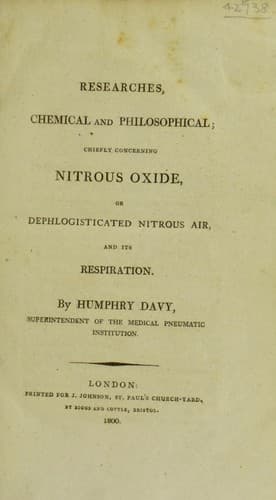
Researches Chemical and Philosophical; Chiefly concerning nitrous oxide: or dephlogisticated nitrous air and its respirationDavy, Humphry, Sir
Science
Researches Chemical and Philosophical; Chiefly concerning nitrous oxide: or dephlogisticated nitrous air and its respiration
Davy, Humphry, Sir
Nitrous oxide
In December, 1799, designing to make a very delicate experiment, with
a view to ascertain if any water was decomposed during the conversion
of nitrous gas into nitrous oxide, by sulphite of potash, I exposed
200 grains of crystalised sulphite of potash, containing great
superabundance of alkali, to 14 cubic inches of nitrous gas, containing
one eighteenth nitrogene. The alkali was employed to preserve any
ammoniac that might be formed, in the free state, as it would otherwise
combine with sulphureous acid.[156]
[156] Sulphureous acid saturates more potash than sulphuric acid, so
that most probably during the conversion of sulphite of potash into
sulphate, portions of sulphureous acid are disengaged.
The volume of gas diminished with great rapidity; in two hours and
ten minutes it was reduced to 6⁴/₅, which I considered as the limit
of diminution. Accidentally, however, suffering it to remain for three
hours longer, I was much surprised by finding that not quite 2 cubic
inches remained, which consisted of nitrous oxide, mingled with the
nitrogene that existed before the experiment.
In accounting theoretically for this phænomenon, different suppositions
necessarily presented themselves.
1st, It was possible, that though sulphite of potash, and potash,
separately possessed no action on free nitrous oxide, yet in
combination they might exert such affinities upon it as either to
absorb it, or make it enter into new combinations.
2dly. It was more probable that the caustic potash, though incapable
of condensing aëriform nitrous oxide, was yet possessed of a strong
affinity for it when in the _nascent state_, and that the nitrous oxide
condensed in the experiment had been combined in this state with the
free alkali.
To ascertain if the compound of potash and sulphite of potash with
sulphate, was capable of acting upon nitrous oxide, I suffered a
quantity of this substance to remain in contact with the gas for near a
day: no change whatever took place.
To determine whether the diminution of nitrous oxide depended upon its
absorption in the nascent state, by the peculiar compound of potash and
sulphite of potash, or if it was simply owing to the alkali.
I mingled a solution of sulphite of potash with caustic soda; the
salt, after being evaporated at a low temperature, was exposed to
nitrous gas. The nitrous oxide formed was absorbed, but in rather less
quantities than when alkaline sulphite of potash was employed.
Hence it was evident that the alkali was the agent that had condensed
the nitrous oxide in those experiments, for soda is incapable of
combining either with sulphate, or sulphite of potash.
Public-domain text, read in full here on John Shaqi.
Reviews
Reviews
No reviews yet
Be the first to share your thoughts on this work.
Elsewhere in the archive
Join the Discussion
Join the discussion
Sign in to leave a comment or review.
Sign InorCreate an account