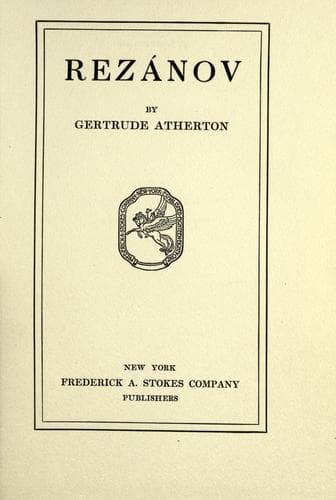
California -- History -- Fiction; Rezanov, Nikolai Petrovich, 1764-1807 -- Fiction
No doubt that his great schemes would die with him, and were he
remembered at all it would be as a dreamer; or as a failure because he
had died before accomplishing what his brain and energy and enthusiasm
alone could force to fruition. None realized better than he the
paucity of initiative and executive among the characteristics of the
Slav. What mattered it? He had had glimpses more than once of the
apparently illogical sequence of life, the vanity of human effort, the
wanton cruelty of Nature. He had known men struck down before in the
maturity of their usefulness, cities destroyed by earthquake or
hurricane in the fairest and most promising of their days: public men,
priests, parents, children, wantons, criminals, blotted out with equal
impartiality by a brutal force that would seem to have but a casual use
for the life she flung broadcast on her planets. Man was the helpless
victim of Nature, a calf in a tiger's paws. If she overlooked him, or
swept him contemptuously into the class of her favorites, well and
good; otherwise he was her sport, the plaything of her idler moments.
Those that cried "But why?" "What reason?" "What use?" were those
that had never looked over the walls of their ego at the great dramatic
moments in the career of Nature, when she made immortal fame for
herself at the expense of millions of pigmies.
And if his energies, his talents, his usefulness, were held of no
account, at least he could look back upon a past when he would have
seemed to be one of the few supreme favorites of the forces that shaped
man's life and destiny. Until he had started from Kronstadt four years
before on a voyage that had humiliated his proud spirit more than once,
and undermined as splendid a physique as ever was granted to even a
Russian, he had rolled the world under his foot. With an appearance
and a personal magnetism, gifts of mind and manner and character that
would have commanded attention amid the general flaccidity of his race
and conquered life without the great social advantages he inherited, he
had enjoyed power and pleasure to a degree that would have spoiled a
coarser nature long since. True, the time had come when he had cared
little for any of his endowments save as a means to great ends, when
all his energies had concentrated in the determination to live a life
of the highest possible usefulness--without which man's span was but
existence--his ambitions had cohered and been driven steadily toward a
permanent niche in history; then paled and dissolved for an hour in the
glorious vision of human happiness.
Public-domain text, read in full here on John Shaqi.
Reviews
Reviews
No reviews yet
Be the first to share your thoughts on this work.
Elsewhere in the archive
Join the Discussion
Join the discussion
Sign in to leave a comment or review.
Sign InorCreate an account