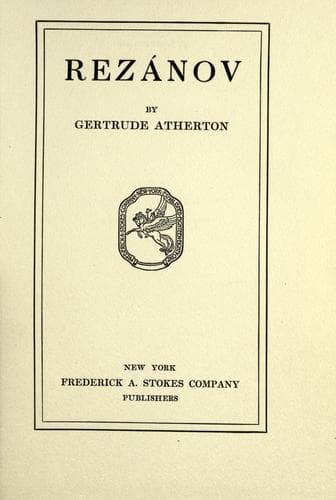
California -- History -- Fiction; Rezanov, Nikolai Petrovich, 1764-1807 -- Fiction
And wholly as he might realize man's insignificance among the blind
forces of nature, he could accept it philosophically and die with his
soul uncorroded by misanthropy, that final and uncompromising admission
of failure. The misanthrope was the supreme failure of life because he
had not the intelligence to realize, or could not reconcile himself to,
the incomplete condition of human nature. Man was made up of little
qualities, and aspirations for great ones. Many yielded in the
struggle and sank into impotent discontent among the small material
things of life, instead of uplifting themselves with the picture of the
inevitable future when development had run its course, and indulgently
pitying the children of their own period who so often made life hateful
with their greed, selfishness, snobbery--most potent obstacle to human
endeavor--and injustice. The bad judgment of the mass! How many
careers it had balked, if not ruined, with its poor ideals, its mean
heroes, its instinctive avoidance of superior qualities foreign to
itself, its contemptible desire to be identified with a fashion. It
was this low standard of the crowd that induced misanthropy in many
otherwise brave spirits who lacked the insight to discern the divine
spark underneath, the persistence, sure of reward, to fight their way
to this spark and reveal it to the gaze of astonished and flattered
humanity. Rezanov's very arrogance had led him to regard the mass of
mankind as but one degree removed from the nursery; his good nature and
philosophical spirit to treat them with an indulgence that kept
sourness out of his cynicism and inevitably recurring weariness and
disgust; his ardent imagination had consoled itself with the vision of
a future when man should live in a world made reasonable by the triumph
of ideals that now lurked half ashamed in the high spaces of the human
mind.
He looked back in wonder at the moment of wild regret and protest--the
bitterer in its silence--when they had told him he must die; when in
the last rally of the vital forces he had believed his will was still
strong enough to command his ravaged body, to propel his brain, still
teeming with a vast and complicated future, his heart, still warm and
insistent with the image it cherished, on to the ultimates of ambition
and love. How brief it had been, that last cry of mortality, with its
accompaniment of furious wonder at his unseemly and senseless cutting
off. In the adjustment and readjustment of political and natural
forces the world ambled on philosophically, fulfilling its inevitable
destiny.
Public-domain text, read in full here on John Shaqi.
Reviews
Reviews
No reviews yet
Be the first to share your thoughts on this work.
Elsewhere in the archive
Join the Discussion
Join the discussion
Sign in to leave a comment or review.
Sign InorCreate an account