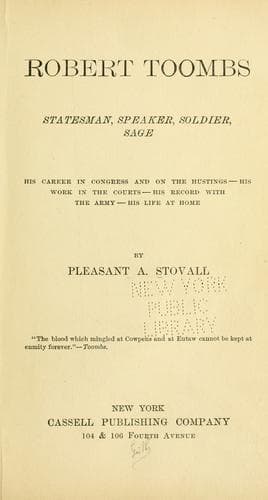
Robert Toombs: Statesman, Speaker, Soldier, SageStovall, Pleasant A.
History
Robert Toombs: Statesman, Speaker, Soldier, Sage
Stovall, Pleasant A.
Toombs, Robert Augustus, 1810-1885
In January, 1862, the General Assembly of Georgia elected Robert Toombs
a member of the Confederate States Senate. Benjamin H. Hill was to be
his colleague. But General Toombs had a different conception of his
duty. He realized that he had been prominent in shaping the events that
had led to the Civil War, and he did not shirk the sharpest
responsibility. He felt that his duty was in the field. He had condemned
the rush for civil offices and what he called "bombproof positions," and
he wished at least to lead the way to active duty by remaining with his
army.
Two months later an effort was made by some of his friends to have him
appointed Secretary of War. This would have brought him in close contact
with the army, which he was anxious to serve. The parties behind this
movement believed that the great abilities of Mr. Toombs should not be
hidden behind the command of a brigade. He would have made an ideal war
minister. His genius for details and his ability to manage affairs and
plan campaigns would have overmatched Edwin M. Stanton. But Mr. Toombs
promptly cut off this movement in his behalf.
On 22d March, 1862, he wrote to his wife from Orange Court House, Va.:
I thought I had been very explicit on that point. I would
not be Mr. Davis' chief clerk. His Secretary of War can
never be anything else. I told my friends in Richmond to
spare me the necessity of declining if they found it in
contemplation. I have not heard that they had any occasion
to interfere.... So far as I am concerned, Mr. Davis will
never give me a chance for personal distinction. He thinks
I pant for it, poor fool. I want nothing but the defeat of
the public enemy and to retire with you for the balance of
my life in peace and quiet in any decent corner of a free
country. It may be his injustice will drive me from the
army, but I shall not quit it until after a great victory,
in which I shall have the opportunity of doing something
for the country. The day after such an event I shall
retire, if I live through it. I have grievances enough now
to quit, but I shall bide my time. I get along very well
with the army. I have not seen Johnston but once; he was
polite and clever. George W. Smith I see every day. He is a
first-rate gentleman and a good officer. I hear from
Stephens constantly, but from nobody else in Richmond....
You say you pray for me daily. I need it. Put it in your
prayers that if it be the will of God that I shall fall, a
sacrifice in this great conflict, that I may meet it as
becomes a gentleman.
Public-domain text, read in full here on John Shaqi.
Reviews
Reviews
No reviews yet
Be the first to share your thoughts on this work.
Elsewhere in the archive
Join the Discussion
Join the discussion
Sign in to leave a comment or review.
Sign InorCreate an account