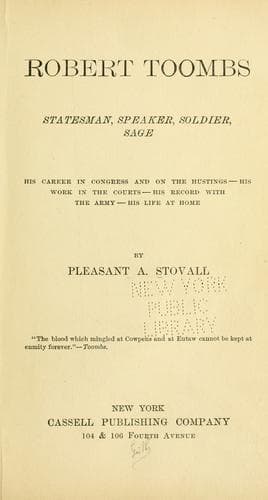
Robert Toombs: Statesman, Speaker, Soldier, SageStovall, Pleasant A.
History
Robert Toombs: Statesman, Speaker, Soldier, Sage
Stovall, Pleasant A.
Toombs, Robert Augustus, 1810-1885
An instance of General Toombs' impatience under red-tape rules may be
recalled. A member of his brigade was taken ill, and he secured for him
entrance into the hospital of Richmond. The hospital was crowded;
regulations were stringent, and under some technical ruling his sick
soldier was shipped back to his brigade. Toombs was fired with
indignation. He proceeded to sift the affair to the bottom, and was told
that General Johnston had fixed the rules. This did not deter him.
Riding up to the commander's tent and securing admission, he proceeded
to upbraid the general as only Toombs could do. When he returned to his
headquarters he narrated the circumstance to Dr. Henry H. Steiner, his
brigade surgeon and lifelong friend. Dr. Steiner, who had been a surgeon
in the regular army, and had served in the Mexican war, was a better
tactical officer than Toombs. He was himself fearless and upright, but
full of tact and discretion. "General," said Dr. Steiner, "you have been
too rash; you will be arrested." Toombs replied that he thought so, too.
He held himself in anticipation for two or three days, but he was not
disturbed. When he was finally summoned to General Johnston's tent, it
was to consult over a plan of movement, and it was noticed that Toombs
was the only brigadier in counsel. General Johnston subsequently
remarked that Toombs was the biggest brained man in the Confederacy. The
boldness and clearness of the impetuous Georgian had captured the grim
hero of Manassas, who forgave the affront in the face of the
overmastering mind of the man.
General McClellan reached Fortress Monroe, April 2, 1862, and commenced
his march up the peninsula. The country is low and flat, and the season
was unusually wet and dismal. The objective point was Richmond,
seventy-five miles away, and the first obstruction met by the Federal
army was at Yorktown. The defense adopted by General Magruder was a
series of dams extending along the Warwick River, which stretched across
the peninsula from the York to the James River, a distance of thirteen
miles. The fords along the Warwick had been destroyed by dams defended
by redoubts, and the invader and defender were stationed in dense
swamps. At dam No. 1 Toombs' troops were often under fire. They fought
with spirit. Each detachment was on duty defending the dam forty-eight
hours, and between long exposure in the trenches, the frequent alarms,
and sharp sorties, the service was very exhausting. It was only possible
to change troops at night. On the 16th of April Toombs writes:
One of my regiments, the 17th Georgia, had a skirmish day
before yesterday. They acted splendidly, charging the
Yankees, and driving them from the rifle-pits, killing,
wounding, and taking prisoners over one hundred of the
enemy. I lost but two killed and a few wounded.
Public-domain text, read in full here on John Shaqi.
Reviews
Reviews
No reviews yet
Be the first to share your thoughts on this work.
Elsewhere in the archive
Join the Discussion
Join the discussion
Sign in to leave a comment or review.
Sign InorCreate an account