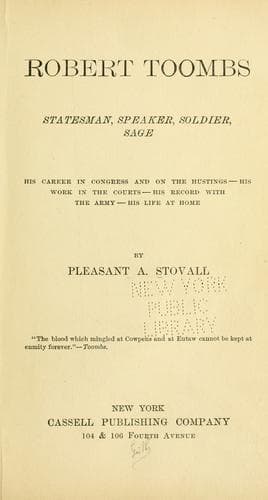
Robert Toombs: Statesman, Speaker, Soldier, SageStovall, Pleasant A.
History
Robert Toombs: Statesman, Speaker, Soldier, Sage
Stovall, Pleasant A.
Toombs, Robert Augustus, 1810-1885
The report of the House Committee was prepared by Robert Toombs. It was
the most admirable and statesmanlike document of that day. Mr. Toombs
said that deliberation had resulted in the conviction that the measure
suggested by His Excellency should not be adopted. While his committee
was duly sensible of and deeply regretted the pecuniary embarrassment of
many of their fellow-citizens, he felt constrained by a sense of public
duty to declare that he deemed it unwise and impolitic to use the
credit, and pledge the property and labor of the whole people, to supply
the private wants of a portion only of the people. The use of the public
credit, he went on to say, was one of the most important and delicate
powers which a free people could confide in their representatives; it
should be jealously guarded, sacredly protected, and cautiously used,
even for the attainment of the noblest patriotic ends, and never for the
benefit of one class of the community to the exclusion or injury of the
rest, whether the demand grew out of real or supposed pecuniary
difficulties. To relieve these difficulties by use of the public credit
would be to substitute a public calamity for private misfortune, and
would end in the certain necessity of imposing grievous burdens in the
way of taxes upon the many for the benefit of the few. All experience,
Mr. Toombs went on to declare, admonish us to expect such results from
the proposed relief measures, to adopt which would be to violate some
of the most sacred principles of the social compact. All free
governments, deriving their just powers from, and being established for
the benefit of, the governed, must necessarily have power over the
property, and consequently the credit, of the governed to the extent of
public use, and no further. And whenever government assumed the right to
use the property or credit of the people for any other purpose, it
abused a power essential for the perfection of its legislative duties in
a manner destructive of the rights and interests of the governed, and
ought to be sternly resisted by the people. The proposed measures, he
contended, violated these admitted truths, asserted the untenable
principle that governments should protect a portion of the people, in
violation of the rights of the remainder, from the calamities consequent
on unpropitious seasons and private misfortunes.
Public-domain text, read in full here on John Shaqi.
Reviews
Reviews
No reviews yet
Be the first to share your thoughts on this work.
Join the Discussion
Join the discussion
Sign in to leave a comment or review.
Sign InorCreate an account