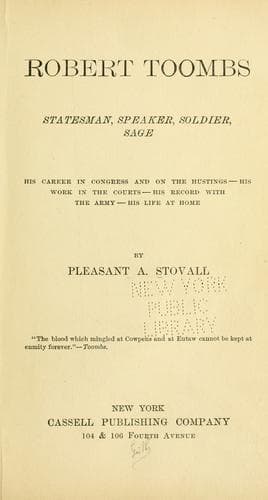
Robert Toombs: Statesman, Speaker, Soldier, Sage — John Shaqi
Robert Toombs: Statesman, Speaker, Soldier, SageStovall, Pleasant A.
History
Robert Toombs: Statesman, Speaker, Soldier, Sage
Stovall, Pleasant A.
Toombs, Robert Augustus, 1810-1885
He must have been an indifferent or careless spectator of similar
financial schemes, Mr. Toombs declared, who could persuade himself that
this plan of borrowing money, to lend again at the same rate of
interest, could be performed without loss to the State. That loss must
be supplied by taxation, and to that extent, at least, it will operate
so as to legislate money from the pocket of one citizen to that of
another. The committee declared that it knew of no mode of legislative
relief except the interposition of unconstitutional, unwise, unjust, and
oppressive legislation between debtor and creditor, which did not need
their condemnation.
The argument was exhaustive and convincing. Never were the powers of the
State or the soundness of public credit more strongly set forth. The
whole scheme of relief was abandoned, and the General Assembly
adjourned.
The relief measures, however, had a great effect upon the campaign.
Rejected in the legislature under the rattling fire and withering
sarcasm of Toombs, they were artfully used on the hustings. "McDonald
and Relief" was the slogan. Men talked airily about "deliverance and
liberty." Mr. Toombs declared that "humbuggery was reduced to an exact
science and demonstrated by figures." The Act compelling the banks to
make cash payments was represented as an unwise contraction of the
currency and a great oppression to the people. Governor McDonald was
consequently reelected over William C. Dawson, the Whig nominee.
Robert Toombs was not a candidate for reelection in 1841. He worked hard
at the polls for the Whig ticket, and although his candidate for
Governor received a majority of one in Wilkes County, the Whigs were
defeated for the legislature. When he returned to the Assembly in 1842
he still found Governor McDonald and the Democrats supporting a central
bank and the sub-treasury. They clamored to restore public finances to
the old system. The Democrats held the legislature and elected to the
United States Senate Walter T. Colquitt over Charles J. Jenkins.
Although a member of the minority party, Mr. Toombs was appointed
chairman of the Judiciary Committee. Here his high character and moral
courage shone conspicuously. He proved a stone wall against the perfect
flood of legislation designed for popular relief. To use his own words:
"The calendar was strong with a heterogeneous collection of bills
proposing stay-laws." He reported as "unwise, inexpedient, and
injurious," proposed Acts "to protect unfortunate debtors"; "to redeem
property in certain cases"; also a bill to "exempt from levy and sale
certain classes of property." He held with Marshall the absolute
inviolability of contracts; he believed in common honesty in public and
private life; he was strict in all business obligations; he denounced
the Homestead Act of 1868, and declared in his last days that there was
"not a dirty shilling in his pocket." Mr. Toombs was nothing of the
demagogue.
Public-domain text, read in full here on John Shaqi.
Reviews
Reviews
No reviews yet
Be the first to share your thoughts on this work.
Join the Discussion
Join the discussion
Sign in to leave a comment or review.
Sign InorCreate an account