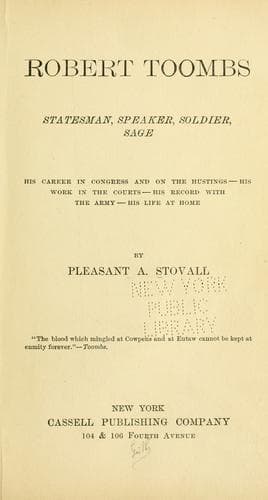
Robert Toombs: Statesman, Speaker, Soldier, SageStovall, Pleasant A.
History
Robert Toombs: Statesman, Speaker, Soldier, Sage
Stovall, Pleasant A.
Toombs, Robert Augustus, 1810-1885
Robert Toombs had already made his appearance in national politics in
1840. Although still a member of the Georgia Legislature, he took a deep
interest in the success of the Whig ticket for President. His power as a
stump speaker was felt in eastern Georgia, where the people gathered at
the "log cabin and hard cider" campaigns. The most daring feat of young
Toombs, just thirty years old, was in crossing the Savannah River and
meeting George McDuffie, the great Democrat of South Carolina, then in
the zenith of his fame. An eye-witness of this contest between the
champions of Van Buren and Harrison declared that McDuffie was
"harnessed lightning" himself. He was a nervous, impassioned speaker.
When the rash young Georgian crossed over to Willington, S. C., to meet
the lion in his den, Toombs rode horseback, and it was noticed that his
shirt front was stained with tobacco juice, and yet Toombs was a
remarkably handsome man. "Genius sat upon his brow, and his eyes were as
black as death and bigger than an ox's." His presence captivated even
the idolators of McDuffie. His argument and invective, his overpowering
eloquence, linger in the memory of old men now. McDuffie said of him: "I
have heard John Randolph of Roanoke, and met Burgess of Rhode Island,
but this wild Georgian is a Mirabeau."
In 1844 Robert Toombs was a delegate to the Baltimore convention which
nominated Henry Clay, and during this visit he made a speech in New York
which attracted wide attention. It threatened to raise a storm about his
head in Georgia. In his speech he arraigned Mr. Calhoun for writing his
"sugar letter" to Louisiana, and for saying that he would protect sugar
because it was the production of slave labor. Mr. Toombs declared: "If
any discrimination is made between free and slave labor it ought to be
in favor of free labor." "But," said he, "the Whigs of Georgia want no
such partial protection as Mr. Calhoun offers; they want protection for
all classes of labor and home industry. The Whigs protest against these
efforts to prejudice the South against the North, or the North against
the South. They have a common interest as well as a common history. The
blood that was mingled at Yorktown and at Eutaw cannot be kept at enmity
forever. The Whigs of Bunker Hill are the same as the Whigs of Georgia."
Mr. Toombs was actually charged in this campaign with being an
Abolitionist. He was accused of saying in a speech at Mallorysville,
Ga., during the Harrison campaign, that slavery was "a moral and
political evil." This was now brought up against him. Mr. Toombs
admitted saying that slavery was a political evil. He wrote a ringing
letter to his constituents, in which he declared that "the affected fear
and pretended suspicion of a part of the Democratic press in relation to
my views are well understood by the people. I have no language to
express my scorn and contempt for the whole crew. I have no other reply
to make to these common sewers of filth and falsehood.
Public-domain text, read in full here on John Shaqi.
Reviews
Reviews
No reviews yet
Be the first to share your thoughts on this work.
Join the Discussion
Join the discussion
Sign in to leave a comment or review.
Sign InorCreate an account