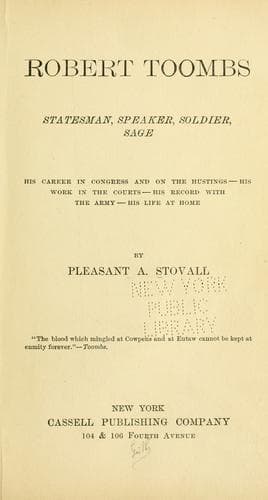
Robert Toombs: Statesman, Speaker, Soldier, SageStovall, Pleasant A.
History
Robert Toombs: Statesman, Speaker, Soldier, Sage
Stovall, Pleasant A.
Toombs, Robert Augustus, 1810-1885
Entering public life about the same time, living a short distance apart,
professing the same political principles, practicing in the same courts
of law, were Alexander H. Stephens of Taliaferro and Robert Toombs of
Wilkes. Entirely unlike in physical organism and mental make-up,
differing entirely in origin and views of life, these two men were close
personal friends, and throughout an eventful period of more than half a
century, preserved an affectionate regard for each other.
Mr. Stephens was delicate, sensitive, conservative, and sagacious, while
Toombs was impetuous, overpowering, defiant, and masterful. Stephens was
small, swarthy, fragile, while Toombs was leonine, full-blooded, and
majestic. And yet in peace and war these two men walked hand in hand,
and the last public appearance of Robert Toombs was when, bent and
weeping, he bowed his gray head at the coffin and pronounced the funeral
oration over Alexander Stephens.
In the General Assembly of 1843, Robert Toombs was a member of the
house, but his ability and power had marked him as a candidate for
Congress, and Mr. Stephens had already been promoted from the State
Senate to a seat in the national legislature at Washington. The law
requiring the State to choose congressmen on the district plan had been
passed, and the General Assembly was then engaged in laying off the
counties into congressional districts. The bill, as first reported,
included the counties of Wilkes and Taliaferro in the second district of
Georgia. Here was a problem. Toombs and Stephens had been named as Whig
candidates for the Clay campaign of 1844. To have them clash would have
been to deprive the State of their talents in the national councils. It
would be interesting to speculate as to what would have been the result
had these two men been opposed. Stephens was naturally a Union man, and
was no very ardent advocate of slavery. Toombs inherited the traditions
of the Virginia landowners. It is not improbable that the firmness of
the one would have been a foil for the fire of the other. History might
have been written differently had not the conference committee in the
Georgia Legislature in 1843 altered the schedule of districts, placing
Taliaferro in the seventh and Wilkes in the eighth Congressional
district. Both were safely Whig, and the future Vice-President and
premier of the Southern Confederacy now prepared for the canvass which
was to plunge them into their duties as members of the national
Congress.
Public-domain text, read in full here on John Shaqi.
Reviews
Reviews
No reviews yet
Be the first to share your thoughts on this work.
Join the Discussion
Join the discussion
Sign in to leave a comment or review.
Sign InorCreate an account