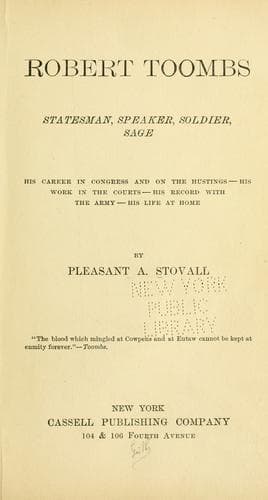
Robert Toombs: Statesman, Speaker, Soldier, SageStovall, Pleasant A.
History
Robert Toombs: Statesman, Speaker, Soldier, Sage
Stovall, Pleasant A.
Toombs, Robert Augustus, 1810-1885
Mr. Toombs made a most elaborate speech against this bill in July, 1846.
If his Oregon speech had shown thorough familiarity with the force and
effect of treaties and the laws of nations, his tariff speech proved him
a student of fiscal matters and a master of finance. His genius, as
Jefferson Davis afterward remarked, lay decidedly in this direction. Mr.
Toombs announced in his tariff speech that the best of laws, especially
tax laws, were but approximations of human justice. He entered into an
elaborate argument to controvert the idea that low tariff meant
increased revenue. The history of such legislation, he contended, had
been that the highest tariff had raised the most money. Mr. Toombs
combated the _ad valorem_ principle of levying duty upon imports.
Mr. Toombs declared to his constituents in September, 1846, that the
President had marched his army into Mexico without authority of law.
"The conquest and dismemberment of Mexico, however brilliant may be the
success of our arms," said he, "will not redound to the glory of our
republic."
The Whigs approached the Presidential campaign of 1848 with every chance
of success. They still hoped that the Sage of Ashland might be the
nominee. George W. Crawford, ex-Governor of Georgia, and afterward
member of the Taylor Cabinet, perceiving that the drift in the West was
against Mr. Clay, offered a resolution in the Whig convention that
"whatever may have been our personal preferences, we feel that in
yielding them at the present time, we are only pursuing Mr. Clay's own
illustrious example." Mr. Toombs stated to his constituents that Clay
could not be nominated because Ohio had declared that no man who had
opposed the Wilmot Proviso could get the vote of that State. The Whigs,
who had opposed the Mexican war, now reaped its benefits by nominating
one of its heroes to the Presidency, and Zachary Taylor of Louisiana
became at once a popular candidate. Millard Fillmore of New York was
named for vice president, and "Rough and Ready" clubs were soon
organized in every part of Georgia. The venerable William H. Crawford
headed the Whig electoral ticket in Georgia, while Toombs, Stephens, and
Thomas W. Thomas led the campaign.
The issue of the campaign in Georgia was the Clayton compromise which
the Georgia senators had sustained, but which Stephens and Toombs had
defeated in the House. This compromise proposed that all questions
concerning slavery in the governments of the ceded territory be referred
to the Supreme Court of the United States. Mr. Toombs declared that the
Mexican law prohibiting slavery was still valid and would so remain;
that Congress and not the courts must change this law.
Public-domain text, read in full here on John Shaqi.
Reviews
Reviews
No reviews yet
Be the first to share your thoughts on this work.
Join the Discussion
Join the discussion
Sign in to leave a comment or review.
Sign InorCreate an account