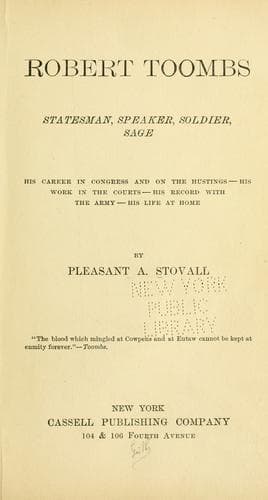
Robert Toombs: Statesman, Speaker, Soldier, SageStovall, Pleasant A.
History
Robert Toombs: Statesman, Speaker, Soldier, Sage
Stovall, Pleasant A.
Toombs, Robert Augustus, 1810-1885
The Clayton compromise, Mr. Toombs said, was only intended as "the
Euthanasia of States' Rights. When our rights are clear, security for
them should be free from all ambiguity. We ought never to surrender
territory, until it shall be wrested from us as we have wrested it from
Mexico. Such a surrender would degrade and demoralize our section and
disable us for effective resistance against future aggression. It is far
better that this new acquisition should be the grave of the republic
than of the rights and honor of the South--and, from present
indications, to this complexion it must come at last."
Mr. Toombs demanded that what was recognized by law as property in the
slaveholding States should be recognized in the Mexican territory. "This
boon," he pleaded, "may be worthless, but its surrender involves our
honor. We can permit no discrimination against our section or our
institutions in dividing out the common property of the republic. Their
rights are not to be abandoned, or bartered away in presidential
elections."
So Toombs and Stephens were central figures in this national campaign.
It was during this canvass that Mr. Stephens became embroiled with Judge
Francis H. Cone, a prominent lawyer of Georgia and a near neighbor. Mr.
Stephens heard that Judge Cone had denounced him as a traitor for moving
to table the Clayton compromise. Stephens had retorted sharply that if
Cone had said this he would slap his face. After some correspondence the
two men met in Atlanta, September 4, 1848. The trouble was renewed;
Judge Cone denounced Mr. Stephens, who rapped him over the shoulders
with a whalebone cane. Mr. Stephens was a fragile man, and Judge Cone,
with strong physique, closed in and forced him to the floor. During the
scuffle Mr. Stephens was cut in six places. His life for a while was
despaired of. Upon his recovery he was received with wild enthusiasm by
the Whigs, who cheered his pluck and regarded his return to the canvass
as an omen of victory.
Shortly afterward he wrote to Mrs. Toombs, thanking her for her interest
and solicitude during his illness. He managed to write with his left
hand, as he could not use his right. "I hope," he says, "I will be able
to take the stump again next week for old Zach. I think Mr. Toombs has
had the weight of the canvass long enough, and though he has done
gallant service, this but inspires me with the wish to lend all aid in
my power. I think we shall yet be able to save the State. My faith is as
strong as Mr. Preston's which, you know, was enough to move mountains. I
got a letter the other day from Mr. C----, who gives it as his opinion
that Ohio would go for General Taylor. If so, he will be elected. And
you know how I shall hail such a result."
Public-domain text, read in full here on John Shaqi.
Reviews
Reviews
No reviews yet
Be the first to share your thoughts on this work.
Join the Discussion
Join the discussion
Sign in to leave a comment or review.
Sign InorCreate an account