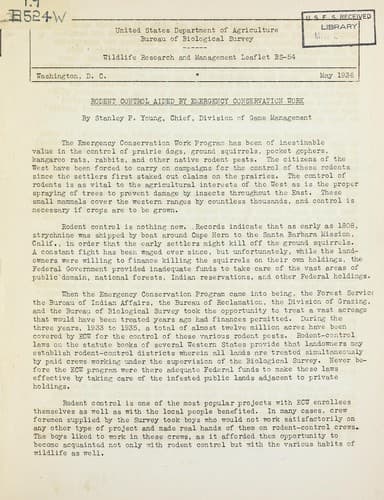
Rodent Control Aided by Emergency Conservation WorkYoung, Stanley Paul
Science
Rodent Control Aided by Emergency Conservation Work
Young, Stanley Paul
Pests -- Control; Rodents -- Control
In order to employ proper methods and place all possible safeguards
around poisoning operations for the protection of beneficial and
harmless species, the Biological Survey has insisted upon approving the
appointments of all men employed on the supervision of rodent-control
work for its various cooperating agencies. This is for the reason that
when poisoning campaigns are properly handled and carefully supervised,
there is little danger of the accidental poisoning of other animals.
The records indicate that there have been practically no cases of
destruction of other forms of life through the E.C.W. rodent-control
program. Naturally, the supervisors not only must know rodent control
but also must be acquainted with the habits and status of wildlife in
general, and in handling the crews they have imparted knowledge to the
beys that will be of permanent benefit to them and to the Nation.
Educational programs were provided as regularly as possible, in
order to tell the C.C.C. enrollees of various wildlife problems. The
entire personnel of E.C.W. camps were shown films depicting the work
of beavers, showing measures for the protection of elk, deer, and
other big-game animals, and portraying the need of sane, sensible
conservation methods, in order that the remnants of our fast-vanishing
forms of valuable wildlife might be preserved. Mimeographed leaflets
on wildlife management studies were made up by district agents of
the Survey for the boys in order that they might be given as broad
instructions as possible in the protection and preservation of species
that are an asset rather than a liability to man's interest. It has
been the attempt of the Biological Survey to make the rodent-control
project a field laboratory for the education of the enrollees in
natural history and wildlife management, and the popularity of the
project among the boys attests to the wisdom of this course. In many
camps more applications for places on rodent-control crews were
received than there were places to fill.
Timeliness of Emergency Aid
Fortunately, the E.C.W. program came at the most opportune time. The
extreme drought throughout the west had forced rodents from the open
lands into adjacent irrigated valleys and mountain meadows, where they
became especially objectionable in their competition with livestock
for the available forage. Livestock and rodents together, during dry
periods, have in many places almost entirely denuded the surface soil
of its vegetation. This has caused the beginning of sheet erosion in
areas where there would still be ample forage for livestock had it not
been for the excessive numbers of rodents. On many areas, grazing by
livestock and rodents combined has practically eliminated the native
grasses, and these are now being replaced with weeds and poisonous
plants. Damage in some instances has amounted to at least 75 percent
of the available forage, and the average loss has probably been
approximately 25 percent.
Public-domain text, read in full here on John Shaqi.
Reviews
Reviews
No reviews yet
Be the first to share your thoughts on this work.
Join the Discussion
Join the discussion
Sign in to leave a comment or review.
Sign InorCreate an account