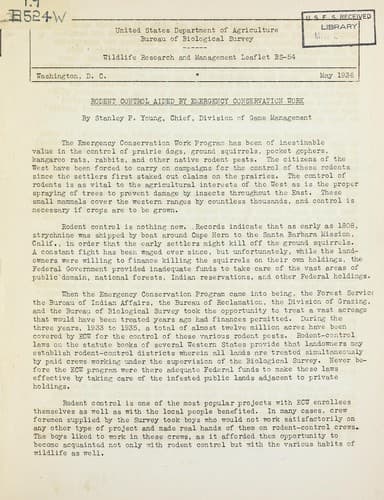
Rodent Control Aided by Emergency Conservation WorkYoung, Stanley Paul
Science
Rodent Control Aided by Emergency Conservation Work
Young, Stanley Paul
Pests -- Control; Rodents -- Control
On some of the Indian reservations of the Southwest, the condition has
been pitiful. On the Navajo Reservation, in particular, the Indians
have carried on a losing fight against drought and rodents. It has
often been necessary for them to replant their corn three and four
times a season, since kangaroo rats and other native rodents dig up the
kernels as rapidly as they are planted. Prior to the spring of 1936,
there had been four years of drought, and this, coupled with rodent
damage, had reduced corn production to the point where the Indians had
barely enough for the spring seeding. All were clamoring for aid, and
in order to save their last crop of corn it was necessary to detail a
foreman with four or five E.C.W. Indians to go from farm to farm and
conduct rodent-control operations.
Forest and Forage Protection
The Forest Service is endeavoring to carry on a reforestation program
throughout much of the cut-over area in the Lake States and the Pacific
Northwest. One of the chief problems to successful reforestation
is the control of rodents, particularly the snowshoe hare. In the
Olympic Forest in Washington, the snowshoe hare has destroyed as much
as 40 percent and damaged 70 percent of the Douglas fir seedlings.
In Michigan and Wisconsin, it was necessary to carry on extensive
rodent-control operations to permit the seedlings to survive. Much of
this work would never have been possible but for E.C.W. help.
In the open area, jack rabbits have become a serious pest. The
Biological Survey, in 1934, received a petition bearing the signatures
of more than 8,000 individuals of eastern Colorado, requesting
Government aid in killing jack rabbits, which were ravaging the meager
stocks of forage left after drought and wind had taken their toll.
The Forest Service recognized that rodent control would be essential
if the Plains Shelterbelt program of planting trees from the Canadian
border to Texas was to be effective, and in 1935 approximately
one-tenth of its entire appropriation for the program was expended for
rodent control under the supervision of the Biological Survey. Crews
patrolled the planted areas constantly to prevent the gnawing of the
seedlings by jack rabbits and pocket gophers.
Aid in Erosion Control
The permanent benefits accruing from the E.C.W. rodent-control program
have been enormous from the standpoint of erosion control alone. An
associate range examiner of the Forest Service has the following to say
regarding the effect of rodents on erosion in the Boise watershed of
Idaho:
Public-domain text, read in full here on John Shaqi.
Reviews
Reviews
No reviews yet
Be the first to share your thoughts on this work.
Join the Discussion
Join the discussion
Sign in to leave a comment or review.
Sign InorCreate an account