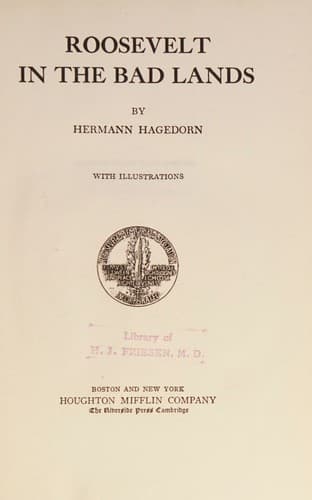
Biography; Frontier and pioneer life -- Dakota Territory; Roosevelt, Theodore, 1858-1919
The wish he had expressed, living, became in a sense a command after
he was dead. The letters he had given me unsealed the lips of the men
who, for thirty-five years, had steadily refused to reveal to
"newspaper fellers" the intimate story of the romantic life they had
shared with the man who became President of the United States. From
Dickinson, North Dakota, came Sylvane Ferris; from Terry, Montana,
came "Joe" Ferris; from Somers, Montana, came "Bill" Merrifield, and,
on their old stamping-ground along the Little Missouri, unfolded, bit
by bit, the story of the four years of Roosevelt's active ranching
life. In the deserted bar-room of the old "Metropolitan Hotel" at
Medora (rechristened the "Rough Riders"); on the ruins of the Maltese
Cross cabin and under the murmuring cottonwoods at Elkhorn, they spun
their joyous yarns. Apart from what they had to tell, it was worth
traveling two thirds across the Continent to come to know these
figures of an heroic age; and to sit at Sylvane Ferris's side as he
drove his Overland along the trails of the Bad Lands and through the
quicksands of the Little Missouri, was in itself not an insignificant
adventure. Mrs. Margaret Roberts, at Dickinson, had her own stories to
tell; and in the wilderness forty miles west of Lake McDonald, on the
Idaho border, John Reuter, known to Roosevelt as "Dutch Wannigan,"
told, as no one else could, of the time he was nearly killed by the
Marquis de Mores. A year later it was Schuyler Lebo who guided me in a
further search for material, fifty miles south from Medora by
buckboard through the wild, fantastic beauty of the Bad Lands. I doubt
if there is any one I missed who had anything to tell of Roosevelt.
So far as any facts relating to Roosevelt or to the Western frontier
can ever be described as "cold," it is a narrative of cold facts which
I have attempted to tell in this book. The truth, in this case, is
romantic enough and needs no embellishment. I have made every effort
to verify my narrative, but, to some extent, I have had to depend,
inevitably, on the character of the men and women who gave me my data,
as every historical writer must who deals not with documents (which
may, of course, themselves be mendacious), but with what is, in a
sense, "raw material." One highly dramatic story, dealing with
Roosevelt's defiance of a certain desperate character, which has at
different times during the past twenty-five years been printed in
leading newspapers and periodicals, told always by the same writer, I
have had to reject because I could find no verification of it, though
I think it may well be true.
Public-domain text, read in full here on John Shaqi.
Reviews
Reviews
No reviews yet
Be the first to share your thoughts on this work.
Join the Discussion
Join the discussion
Sign in to leave a comment or review.
Sign InorCreate an account